
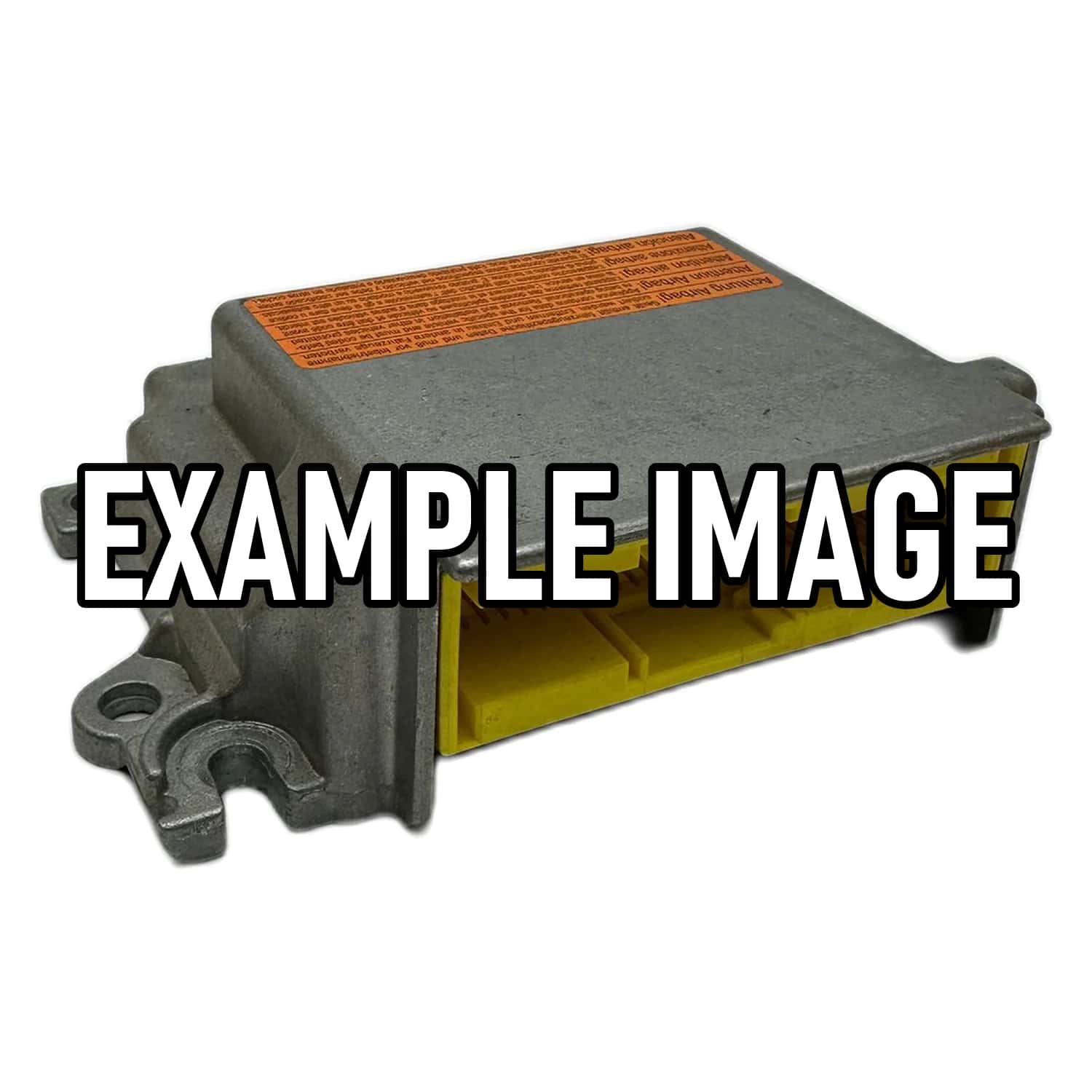

Jaguar E-Pace airbag control unit repair(1)
1 product
What should I consider with Jaguar E-Pace airbag control units?
The airbag technology used in the Jaguar E-Pace varies depending on the model year and equipment, requiring a specialized approach to repairing the airbag control unit. A professional repair ensures the original functionality and full safety of your vehicle by ensuring that all systems function as intended.
Launched in July 2017, the Jaguar E-Pace (internally known as the X540) quickly established itself as a compact luxury SUV. With the introduction of the model, a comprehensive passive safety system was also integrated, centered around the airbag control unit—also known as the SRS Restraint Control Module (RCM).
Over the course of its production run, especially with the significant facelift in 2021, airbag technology has evolved steadily. This applies not only to the number and type of airbags, but also to the complexity and performance of the control unit responsible for reliably detecting collisions and precisely deploying them in an emergency.
A defective airbag control unit, often identified by an illuminated SRS warning light in the cockpit, significantly compromises vehicle safety. Causes of a defect can be varied, from stored crash data after an accident to internal electronic errors and even water damage. A professional repair or reset of the module is therefore essential to restore the full functionality of the protection system and eliminate potential risks.
Which Jaguar E-Pace generations are there?
The Jaguar E-Pace has been produced in one main generation (X540), which received a significant facelift in 2021. Each phase of this generation uses specific airbag control units that meet technological developments and different safety system requirements.
The initial production phase of the Jaguar E-Pace ran from 2017 to 2020. These models were offered with a range of petrol and diesel engines and featured a comprehensive but basic airbag fitment that met the safety standards of the time and was managed by a robust airbag control unit.
With the 2021 facelift, the E-Pace underwent extensive technical and visual modifications. In addition to new mild-hybrid and plug-in hybrid powertrains, the assistance systems and connectivity were also significantly improved, necessitating more direct communication between the airbag control unit and these new systems.
These advancements to the Jaguar E-Pace directly impact the complexity and functionality of the airbag control unit, as it is more closely integrated with other vehicle systems and must collect more precise data for deployment. Despite the continuous development of the vehicle and its safety systems, the basic principle of airbag control remains the same, but specific adaptation to the respective model year and equipment is crucial for a successful repair.
How do I identify my Jaguar E-Pace airbag control unit?
Jaguar E-Pace airbag control units can be precisely identified by their unique part number, the vehicle's year of manufacture, and the vehicle identification number (VIN). This information is crucial to ensure correct compatibility and a professional repair, as different control unit variants were installed for different trim levels and model years.
The part number can usually be found directly on the housing of the airbag control unit. This module is often located under the center console or under the driver's seat and is connected to the vehicle's sensors and airbags via wiring harnesses. It is essential to note this number for accurate identification before ordering a repair, as it provides information about the exact hardware and software version.
In addition to the part number, the exact year of manufacture and VIN play an important role in identifying the appropriate airbag control unit. Newer models from the 2021 facelift, for example, may have control units with updated software or slightly modified hardware that need to communicate with the new mild hybrid systems or advanced driver assistance systems.
Correct identification ensures that the repaired or replaced module not only fits physically, but also communicates perfectly with the rest of the Jaguar E-Pace's software, ensuring full functionality of the SRS system and thus occupant safety. Precise matching is paramount for a successful Jaguar E-Pace airbag control unit repair.
What airbag equipment does the Jaguar E-Pace have?
The Jaguar E-Pace comes standard with a comprehensive suite of airbags, which has been further developed over the years through technological advances and facelifts. Modern models offer enhanced safety packages designed to protect all occupants, even pedestrians, and are coordinated by the central airbag control unit.
From its launch in 2017, the E-Pace was equipped with a standard set of airbags that met high safety standards. These included driver and front passenger airbags, side airbags for the front passengers, side curtain airbags for head protection, and thorax airbags that protect the upper body in the event of a side impact.
A notable and standard feature of the Jaguar E-Pace is the innovative Pedestrian Airbag. This external airbag system deploys under the hood in the event of a pedestrian impact and is designed to mitigate the impact energy, significantly reducing the risk of injury to the pedestrian. This technology underscores Jaguar's commitment to comprehensive safety.
Additionally, ISOFIX child seat anchorages in the rear are standard, increasing safety for younger passengers. The complete passive safety system is complemented by a range of active safety systems such as Dynamic Stability Control, Emergency Brake Assist, and various driver assistance systems, all intelligently networked with the central airbag control unit.
There were also specific recalls for the 2021-2023 Jaguar E-Pace, which affected the passenger airbag and thus indirectly also the airbag control unit, as this is responsible for the correct functioning of the airbag. These actions underscore the complexity and safety-relevant role of the airbag control unit and the necessity of a thorough inspection and, if necessary, reset or replacement of the airbag module by qualified specialists during Jaguar E-Pace airbag control unit repair.
Shipping & repair from Germany
Airbag24 repairs your component in Berlin — usually within 3–4 working days.
Standard shipping within Germany is free; we normally return your part by UPS.
You pay for and insure the inbound shipment to us. On explicit request we ship by express — the extra cost is borne by the customer.
If you withdraw from the contract, you bear the cost of returning the item.