German specialistFree standard shippingFast delivery20,000+ repairs · 10,000+ reviews
 Quality since 2002
How can we help?+49 30 75 65 56 71
Quality since 2002
The airbag technology used in the Lancia Delta varies depending on the model year. Airbag24 professionally repairs control units of all Lancia Delta generations with original functionality and a 2-year warranty.
The Lancia Delta, an icon of automotive history, was produced over several decades in three distinctive generations. The first generation (Tipo 831) defined the image of the sporty compact class from 1979 to 1994 and became known worldwide, particularly for its rally successes. It was followed by the second generation (Tipo 836) from 1993 to 1999, which was built on a new technical basis, and finally the third generation (Tipo 844) from 2008 to 2014, which was positioned as a modern reinterpretation of the compact car.
The airbag systems in the Lancia Delta evolved in parallel with technological advances and increasing safety requirements. While early models of the first generation date back to an era before airbags were generally mandatory and often had no or only rudimentary systems, airbags became a permanent and increasingly important part of the standard equipment in later Lancia Delta variants. This requires a thorough understanding of the respective generation and its specific electronics when repairing defective control units in order to restore optimal functionality.
The Lancia Delta was produced in three generations, each using different airbag control units. The development of the safety system reflects technological progress from 1979 to 2014.
The first Lancia Delta generation (Tipo 831) , produced from 1979 to 1994, included legendary models such as the HF Integrale, HF 4WD, Evoluzione, and Evoluzione II. These vehicles established Lancia as a premium compact model for enthusiasts and motorsports fans. The airbag equipment in this series depends heavily on the year of manufacture and the specific model variant, with safety technology gradually improving over the course of production, and some were equipped with simple airbag systems.
The second generation (Tipo 836) , marketed from 1993 to 1999, was technically based on the Fiat Tipo platform and was designed primarily for comfort and everyday users, without the sporty 4WD options of its predecessors. Driver and passenger airbags increasingly became standard equipment on these models, requiring the airbag control units to be adapted to new safety standards.
The third generation (Tipo 844) , built from 2008 to 2014, presented itself as a modern and technically advanced compact sedan. It integrated comprehensive safety systems with a wider range of state-of-the-art airbag modules and sensors. Precise assignment of the respective airbag control units is crucial to ensuring the correct functionality of the entire safety architecture for series such as the Lancia Delta 831, Lancia Delta 836, Lancia Delta 844, Lancia Delta 2nd generation, Lancia Delta 3rd generation, Lancia Delta HF Integrale, Lancia Delta Evoluzione, and Lancia Delta Evoluzione II.
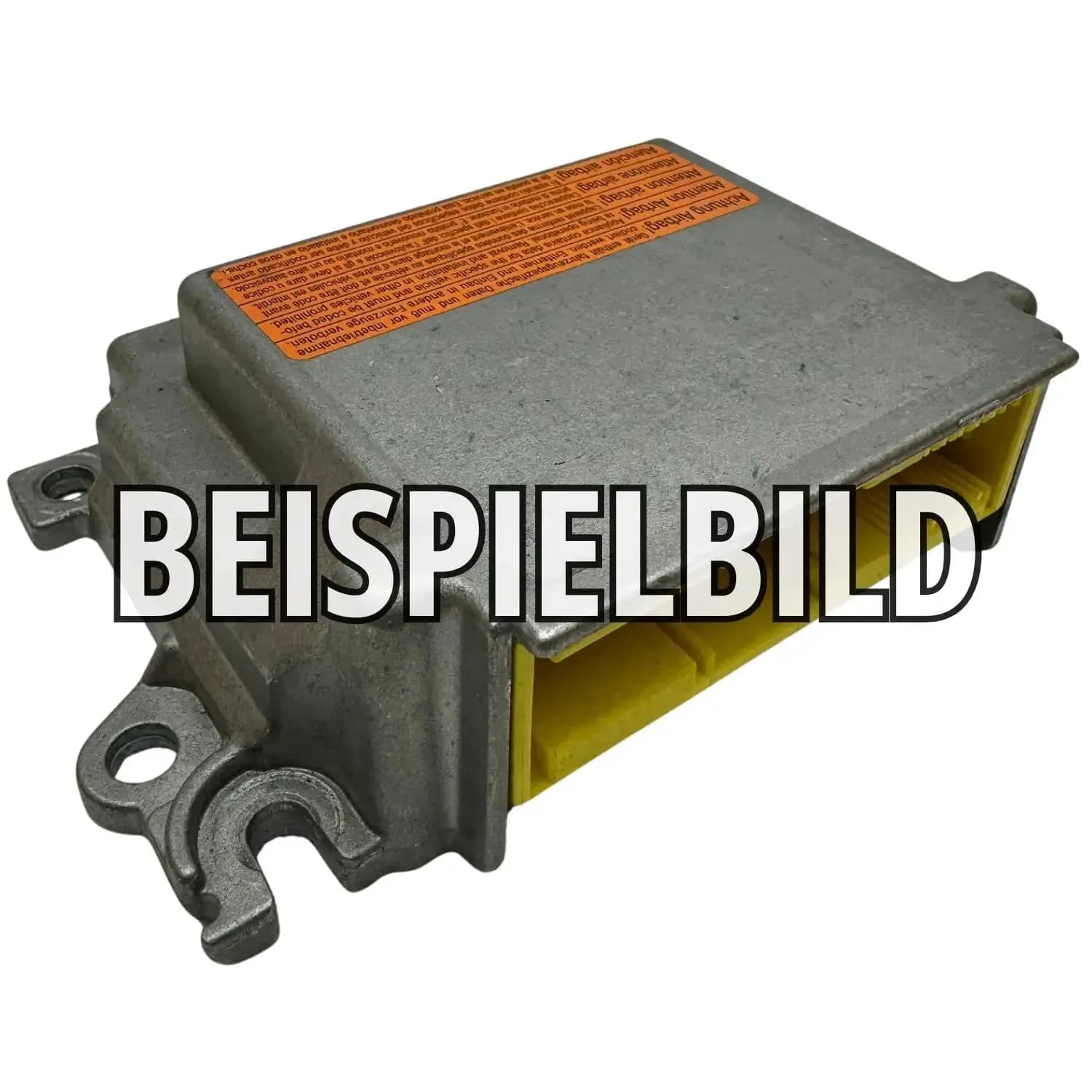
Lancia Delta airbag control units can be uniquely identified by part number, year of manufacture, and vehicle identification number. Each generation uses specific control unit variants for optimal compatibility.
Precise identification of the airbag control unit is absolutely crucial for a successful repair or replacement, especially since a defective control unit can impair the entire airbag function. The most important identifier is the part number affixed to the control unit itself, which provides information about the specific model and exact compatibility. This number is often found on a sticker directly attached to the unit, which is usually located in the center tunnel area or under the seats.
Additionally, the Lancia Delta's model year and the vehicle identification number (VIN) provide valuable clues for correct identification, as airbag systems and their control units have varied considerably across generations. Incorrect identification can not only lead to safety system malfunctions but also prevent the airbag from deploying in an emergency or cause it to deploy accidentally. Therefore, be sure to pay attention to these features when repairing a Lancia Delta airbag control unit to ensure compatibility and safety.
The Lancia Delta's airbag configuration varies depending on the model year and trim level. While early models use basic airbag systems, newer generations feature enhanced safety packages with additional airbag modules.
The airbag equipment in the Lancia Delta reflects the evolution of vehicle safety from the 1970s to the present day. The original first-generation models, especially those from the early model years up until the late 1980s, date back to a time when airbags were not yet standard equipment in compact vehicles. Here, the equipment could vary depending on the market and optional equipment, sometimes even with no airbag at all or with only a driver's airbag.
With progress in the 1990s and the transition to the second generation of the Lancia Delta, airbag equipment became more comprehensive. Driver and passenger airbags were increasingly fitted as standard to significantly increase occupant protection. This generation targeted a broader range of buyers for whom comfort and safety played a greater role in everyday driving and who required a quick repair of a defective system.
Modern third-generation Lancia Delta models (Tipo 844), as well as the sporty top models of the first generation, such as the HF Integrale and Evoluzione variants, featured sophisticated safety packages. These often included not only front airbags, but also seatbelt pretensioners and, in some cases, additional airbag modules designed to modern safety standards and offering comprehensive protection for the driver and passengers. Special airbag repair kits are often available for defective systems today. These can include driver and passenger airbags, seatbelt pretensioners, and even dashboard components, enabling a complete restoration of safety features and extending the lifespan of your Lancia Delta.