Airbag control unit with part number 220591-101
Control unit repairs for part number 220591-101 in our shop:
Your vehicle isn't listed?
Part number “220591-101” isn't linked to every vehicle in our database – we can usually repair it anyway. Select your vehicle and we'll show you the matching repair:
What is the function of Airbag Control Unit 220591-101?
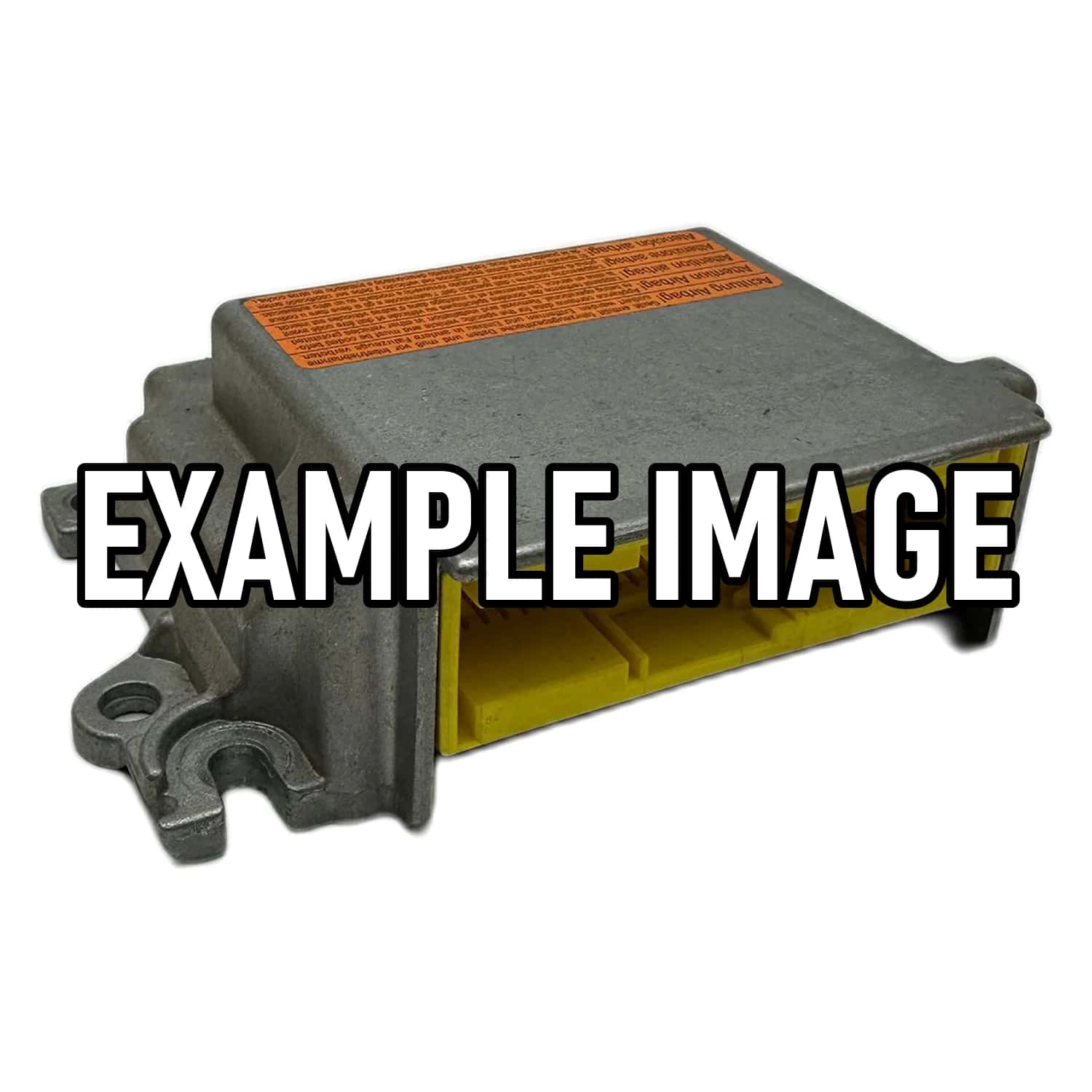
The airbag control unit with part number 220591-101, also known by Toyota’s OEM number 89170-0F100, serves as the central control module for the occupant safety system (SRS) in the Toyota Verso AR20. It processes signals from crash sensors and is responsible for precisely deploying the front and side airbags as well as the seatbelt pretensioners in the event of a collision.
As the central SRS hub, this control unit continuously collects and analyzes data from the vehicle’s distributed acceleration sensors. Its primary task is to reliably detect a collision and activate the appropriate restraint systems within milliseconds.
The unit is specifically designed for the Toyota Verso AR20 vehicle architecture produced between 2009 and 2018. It ensures that all components of the airbag system—from the airbag ignition circuits to the seatbelt pretensioners—are correctly controlled and monitored.
Why does control unit 220591-101 fail?
The most common cause of failure for control unit 220591-101 is the storage of crash data after an accident, which locks out further functionality. In addition, internal electronic faults can lead to defects, often indicated by error codes such as B1000 (“control unit defective”). External factors like water damage, corrosion, or voltage spikes during jump-starts can also harm the sensitive electronics.
Following an airbag deployment, vehicle-specific crash data is permanently stored in the control unit’s memory. This lock cannot be removed through standard workshop diagnostics and prevents the system from becoming operational again, even if all external airbag components have been replaced.
Internal hardware defects are another frequent cause. Faulty components such as voltage regulators, memory chips (EEPROM/Flash), or driver ICs may result in total failure or sporadic malfunctions. Cold solder joints caused by thermal stress and vibrations can also impair performance.
Rarer but equally critical are damages resulting from external influences. Penetrating moisture can cause corrosion on the circuit board and connectors, while improper jump-start procedures—such as reversed polarity or voltage surges—can destroy delicate protection diodes and other components.
How do you recognize a defect in control unit 220591-101?
A defect in control unit 220591-101 primarily manifests as a persistently illuminated airbag warning light on the instrument cluster, sometimes only lighting up about 30 seconds after the engine starts. Additionally, the fault memory often displays code B1000 (“control unit defective”), or communication with the control unit via diagnostic equipment becomes impossible altogether.
The clearest indication is the active SRS or airbag warning light. If the system fails to turn off the light after performing a self-diagnostic check, this points to a serious internal malfunction.
During workshop diagnostics, the issue is frequently revealed through specific error codes. Entries such as “control unit defective,” internal SRS errors, or code B1811 directly indicate a problem within the control unit itself. After an accident, stored crash data is the reason why these errors cannot be cleared.
In some cases, the control unit has completely failed and no longer responds to diagnostic equipment requests. This condition, referred to as “no communication,” makes external fault analysis impossible since access to the fault memory is lost.
In which vehicles is control unit 220591-101 installed?
The airbag control unit with part number 220591-101 and its associated Toyota part number 89170-0F100 is exclusively fitted in the Toyota Verso of the AR20 series. This includes both pre-facelift models from 2009 to 2013 and facelift models from 2013 to 2018. At Airbag24, this control unit is professionally refurbished for the aforementioned vehicle series.
The compatibility of this control unit is limited to a specific vehicle platform to ensure proper operation of the complex safety system. At Airbag24, we repair part number 220591-101 for the following models:
Toyota: Verso (AR20, model years 2009–2013) and Verso (AR20 Facelift, model years 2013–2018).
When replacing or repairing, it is crucial to use the exact part number to ensure that both hardware and software configurations perfectly match the vehicle.
How is control unit 220591-101 professionally repaired?
Professional repair at Airbag24 involves a detailed analysis, erasure of stored crash data at the EEPROM level, and restoration of the electronics. Defective components such as voltage regulators or memory chips are replaced. Finally, full functionality is simulated and verified on a specialized test bench. You receive 2 years' statutory liability for defects on the repair.
Upon receipt of the removed control unit at Airbag24, a comprehensive incoming inspection is performed first. During this process, the fault memory is read out to log error codes such as B1000 or indications of crash data, thereby narrowing down the root cause of the fault.
The core of the repair consists of two steps. First, if present, the crash data is erased directly from the memory chip (EEPROM) using specialized programming devices. Subsequently, the circuit board is inspected at the hardware level. Technicians replace defective components, check supply voltages, and repair cold solder joints.
Following electronic refurbishment, the control unit is tested on a test bench. Here, signals from crash sensors and ignition circuits are simulated to ensure proper functionality under real-world conditions. Only when all internal self-tests pass without error is the repair considered complete, and the control unit functions again like a brand-new part.
Shipping & repair from Germany
Airbag24 repairs your component in Berlin — usually within 3–4 working days.
Standard shipping within Germany is free; we normally return your part by UPS.
You pay for and insure the inbound shipment to us. On explicit request we ship by express — the extra cost is borne by the customer.
If you withdraw from the contract, you bear the cost of returning the item.
4.8

Based on 246 reviews
What our customers say
„Ok.“
 Zsolt Szabólast week
„Works like a charm!“
 Leolylast month
„Everything went perfectly, I can only recommend it.“
Automatically translated · Original: German
 ka irgendwas2 days ago
„From the first phone call, the order processing, to the shipping everything was done very quickly and professionally. Now I still have to send the repaired unit to the Swedish workshop and then hopefully the Honda can fi…“
Automatically translated · Original: German
 Gerd Goldammer3 days ago
„Airbag control unit Fiat 500 was broken. Hard to believe but they can really repair it! Recommendation!!“
Automatically translated · Original: German
 Christian Maegerlein5 days ago
„Everything worked out great! Read out fault memory, sent it in, received offer and sent in the defective control unit. Got it back repaired after 3 days, price exactly as in the offer. It can't get any better 👍“
Automatically translated · Original: German
 Toni Buien6 days ago
„Uncomplicated service. Fast and thorough. Can only recommend.“
Automatically translated · Original: German
 Abdul KS6 days ago
„All great👍“
Automatically translated · Original: German
 Edin Avdiclast week
„All great, fast delivery. Thanks.“
Automatically translated · Original: German
 Andrej Ivanovlast week
„100% satisfied. Everything handled very professionally and transparently. Only the return shipping took too long. This was however due to UPS and less to Aairbag24. Thank you very much“
Automatically translated · Original: German
 Dennis Welast week
„VAG airbag control unit with error B2000 00 reliably repaired. Price very high in comparison, but everything worked out. No exact protocol of what was carried out, probably just newly flashed“
Automatically translated · Original: German
 Tokeh Tokehlast week
„A great shop, even when there are sometimes problems. There are quick responses and very good help. I can only recommend the shop. Thank you very much“
Automatically translated · Original: German
 Sven Wegenerlast week
„Ok.“
Zsolt Szabólast week