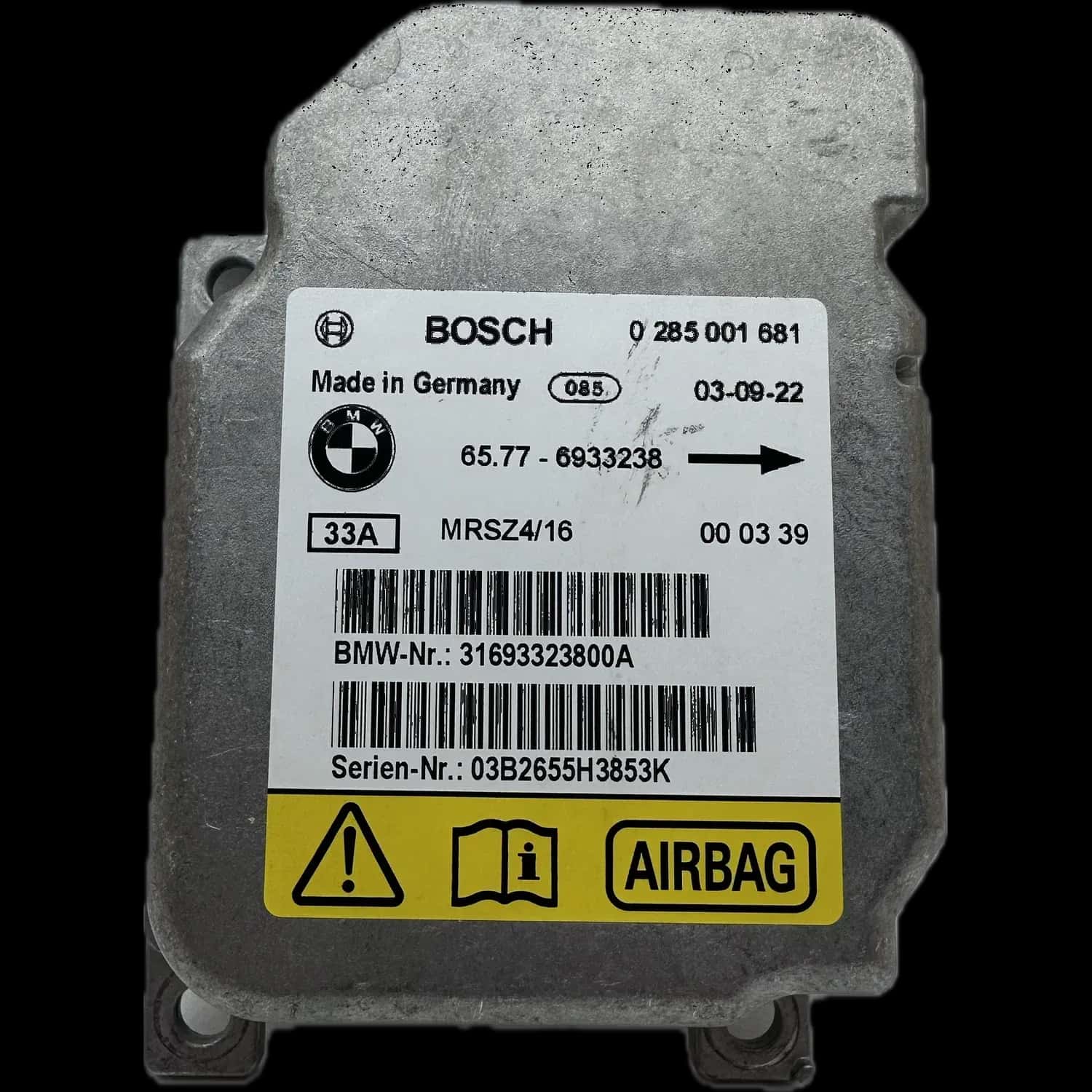
airbag control unit repair BMW X5 E53
from€79.00
 Quality since 2002
The airbag technology used in the BMW X5 varies depending on the model year and generation. Airbag control units in all BMW X5 models can be professionally repaired with original functionality to ensure full safety and system integrity.
Since its market launch in 1999, the BMW X5 has established itself as a leading Sports Activity Vehicle (SAV), consistently setting high safety standards across four generations. Each model generation has brought technological advancements that directly impact the installed airbag systems and their control units.
From the basic front airbags of the first models to the complex, multi-stage safety systems of the latest generations, the BMW X5 has undergone significant development. This evolution requires that each airbag control unit is specifically tailored to the respective generation and its safety architecture. Repairing such control units, for example, in the event of a reported defect or after a crash, therefore requires precise expertise and model-specific software.
The BMW X5 has been produced in four main generations, each with different airbag control units. The evolution of the safety system reflects the vehicle's technological progress from 1999 to the present and demonstrates the continuous improvement in passive safety.
The individual BMW X5 generations are crucial for the correct assignment of the airbag control unit and potential repair requirements:
BMW X5 airbag control units can be uniquely identified by part number, exact year of manufacture, and vehicle identification number (VIN). Each generation uses specific control unit variants for optimal compatibility and successful repair.
Precise identification of the installed airbag control unit is absolutely crucial for a successful repair or replacement. The control unit's part number, often found on a label on the housing, provides information about the exact model and its compatibility. This number is key to ordering the correct replacement parts or performing the appropriate repair measures.
In addition, the exact year of manufacture of your BMW X5 and the complete vehicle identification number (VIN) provide important information. This data can be used to ensure the correct software version and hardware specifications of the airbag control unit, which is especially important if the unit is reported as defective or requires repair after an accident. Incorrect components can impair system function and endanger safety.
The airbag configuration of the BMW X5 varies considerably depending on the model year and trim level, reflecting increasing safety awareness and technological advances. While early models used basic airbag systems, newer generations feature enhanced safety packages with numerous additional airbag modules and modern safety assistance systems.
The evolution of the airbag equipment in the BMW X5 is impressive and reflects the development of automotive safety:
Airbag24 repairs your component in Berlin — usually within 3–4 working days.
Standard shipping within Germany is free; we normally return your part by UPS.
You pay for and insure the inbound shipment to us. On explicit request we ship by express — the extra cost is borne by the customer.
If you withdraw from the contract, you bear the cost of returning the item.