
Honda HR-V airbag control unit repair(3)
3 products
What should I consider with Honda HR-V airbag control units?
The airbag technology used in the Honda HR-V varies depending on the year and model generation. It's crucial to understand the specific requirements of the airbag control unit for your Honda HR-V model to ensure proper repair, especially if the control unit is defective.
The Honda HR-V, a versatile B-segment subcompact SUV, was designed for urban-oriented drivers, small families, and couples seeking an economical and practical vehicle. Its diverse production history, spanning three main generations, brings with it different technical standards that directly influence the airbag systems installed.
The evolution of the airbag systems in the Honda HR-V reflects the general advances in vehicle safety. While the first generation (GH series, 1999–2006) featured basic airbag configurations, newer HR-V models feature more complex systems with advanced airbag modules and integrated safety features such as Honda Sensing®. This means that the airbag control units for newer models from 2016 to 2024 are significantly more complex in design and function, requiring specialized repair.
Which Honda HR-V generations are there?
The Honda HR-V has been produced in three main generations, each with different airbag control units and safety architectures. The evolution of the safety system reflects technological advances from its launch in 1999 to the latest models in 2024.
The first generation of the Honda HR-V (GH series), based on the Honda logo, was offered in Europe, Japan, and Asia from 1999 to 2006, initially as a three-door, later also as a five-door. After a production hiatus of approximately seven years, the Honda Vezel followed in Japan in 2013. From 2015 onward, it was marketed internationally as the second generation HR-V (RU series), often with a facelift around 2019-2021.
The current, third-generation HR-V, in production since 2019/2020, differs significantly by market: Globally, there are smaller HR-V models (also called the Vezel), while the larger ZR-V is offered as a separate model for North America and China. Each of these specific series—honda-hr-v-1st-gen, honda-hr-v-2nd-gen, honda-hr-v-3rd-gen, honda-hr-v-gh, honda-hr-v-ru, honda-hr-v-zz—may require specific airbag control units that must be precisely tailored to the respective generation and model year.
How do I identify my Honda HR-V airbag control unit?
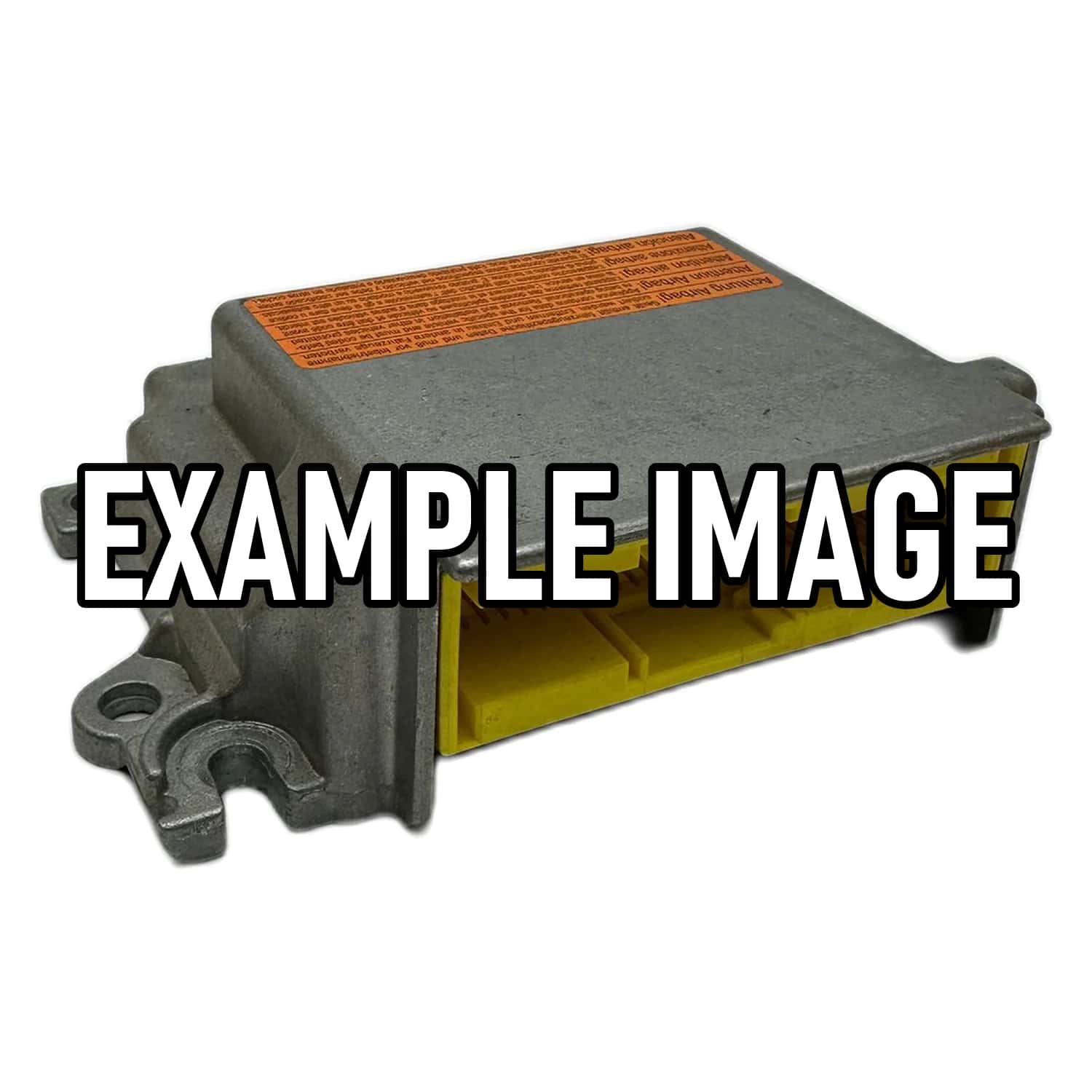
Honda HR-V airbag control units can be uniquely identified by the printed part number, the exact year of manufacture, and the vehicle identification number (VIN). Each generation of the HR-V uses specific control unit variants to ensure optimal compatibility with the respective SRS system and the vehicle's integrated safety systems.
To identify the correct airbag control unit for repair or replacement on your Honda HR-V, the information printed directly on the original part is crucial. This data is essential, as control units can vary significantly depending on the model year and specific trim level, especially between the older GH series, the RU series, and current models.
Precise identification is crucial for the successful repair or replacement of a defective control unit. This is especially relevant for newer models from 2016 to 2024, for which specific OEM modules are available to control the complex airbag and Honda Sensing® systems, and precise identification is the basis for a professional repair.
What airbag equipment does the Honda HR-V have?
The airbag configuration of the Honda HR-V varies significantly depending on the model year, trim level, and the market region the vehicle was sold in. While early models use basic airbag systems, newer generations feature enhanced safety packages with additional airbag modules and integrated safety features.
Honda HR-V models are typically equipped with multiple airbags, including front, side, and curtain airbags, to provide comprehensive occupant protection in the event of a collision. Safety is a critical factor for the target group of young professionals and families, which is why Honda continually equips HR-V models with modern safety technologies.
On newer models, especially from around 2015 onward, airbags and advanced safety features like the Honda Sensing® package are usually standard or included in higher-end trim levels. This package includes technologies such as forward collision warning systems, lane departure warning systems, and adaptive cruise control, which work closely with the SRS airbag system and its central control unit, making its proper function essential to the vehicle's overall safety.
The airbag control modules (ACMs) are critical components for HR-V models built between 2016 and 2024 and are responsible for the correct deployment and function of the entire safety system. Therefore, repairing a defective airbag control module is essential to restore full functionality of the airbag system.
Shipping & repair from Germany
Airbag24 repairs your component in Berlin — usually within 3–4 working days.
Standard shipping within Germany is free; we normally return your part by UPS.
You pay for and insure the inbound shipment to us. On explicit request we ship by express — the extra cost is borne by the customer.
If you withdraw from the contract, you bear the cost of returning the item.