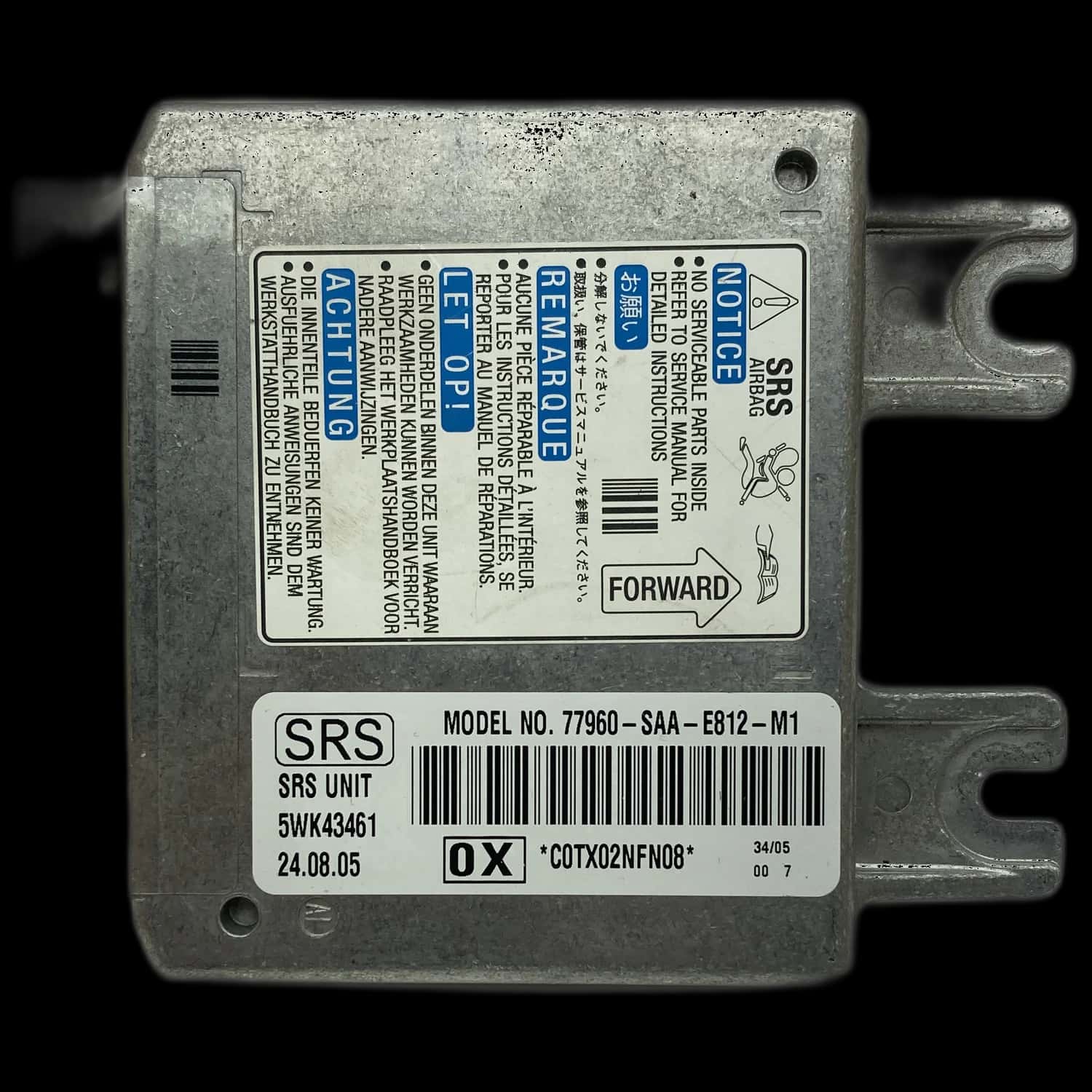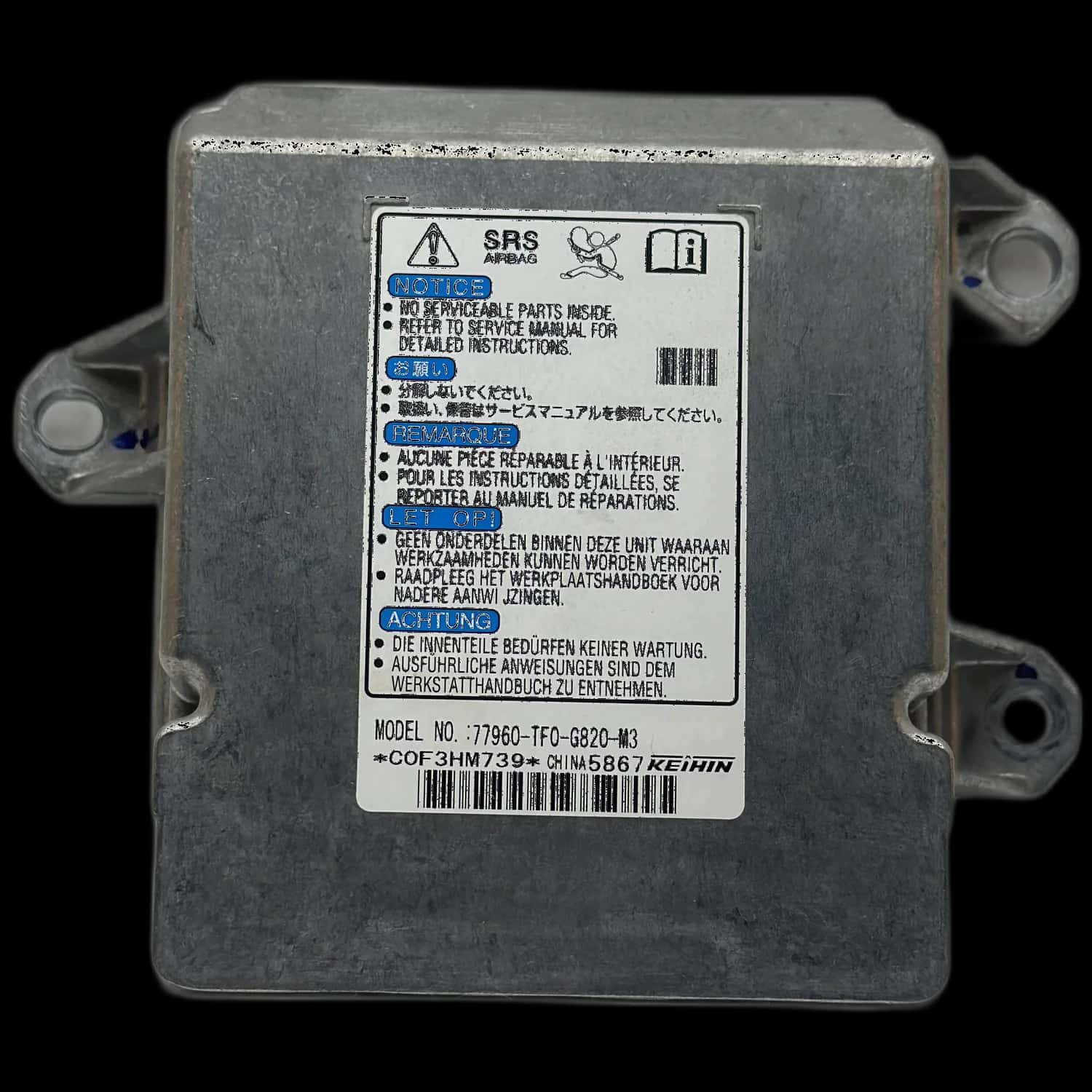
airbag control unit repair Honda Jazz GE
from€66.39
 Quality since 2002
The airbag technology used in the Honda Jazz varies depending on the model year and generation. A professional repair of the airbag control unit ensures the original functionality of the safety system and offers a long-term solution in the event of a defect.
Since the first generation was introduced in 2001, Honda Jazz models have been equipped with airbag systems as standard. Over the years, these systems have been continuously improved to meet increasing safety standards. A defective airbag control unit, often indicated by an illuminated airbag warning light, significantly compromises the vehicle's safety.
The specific configuration of the airbag control unit depends heavily on the respective Honda Jazz generation. This affects not only the software, but also the hardware and the connection to the vehicle's sensors. Therefore, the exact year and correct generation of the vehicle are crucial for repairs.
The Honda Jazz has been produced in five generations, each with a different airbag control unit. The evolution of the safety system reflects technological advances from the first generation in 2001 to the current model.
The first generation of the Honda Jazz, also known internally as the Honda Jazz GD or Honda Jazz GE, was produced from 2001 to around 2007. It was followed by the second generation (approximately 2002-2008) and the third generation (2008-2015), each of which featured further developments in design and technology. The fourth generation (2015-2020), which also includes the Honda Jazz GK and received a facelift from 2018 to 2020, introduced further innovations.
The fifth generation, equipped with even more comprehensive safety systems and including hybrid variants, has been on the market since 2020. For specific facelifts or market regions, the designation Honda Jazz AA also exists, which also appears in the model's history.
These generation changes are crucial for the compatibility of the airbag control unit. A repair must always take into account the specific requirements of the respective model series to ensure full functionality of the system.
Honda Jazz airbag control units can be uniquely identified by part number, year of manufacture, and vehicle identification number (VIN). Each generation uses specific control unit variants for optimal compatibility with the installed sensors and airbag modules.
The part number of the airbag control unit is the most important clue for correct identification. It is usually printed directly on the control unit housing. Since the control unit is often installed under the center tunnel or behind the center console, it may be necessary to remove the corresponding panels to read the number.
In addition to the part number, the exact year of manufacture and the vehicle identification number (VIN) are crucial. This information helps determine the appropriate replacement or repair option and ensures that the repaired control unit works optimally with the vehicle's other components, such as the front or side impact sensors.
The Honda Jazz's airbag configuration varies depending on the model year and trim level. While early models use basic airbag systems, newer generations feature enhanced safety packages with additional airbag modules and sensors.
Starting with the first generation of the Honda Jazz (e.g., Honda Jazz GD, Honda Jazz GE), driver and passenger airbags were standard, controlled by a central airbag control unit. This provided the foundation for occupant safety in this popular subcompact, distinguished by its practicality and urban orientation.
With later generations, especially from the third and fourth generations onwards (e.g., the Honda Jazz GK), the airbag range was gradually expanded. Side airbags for the driver and front passenger, as well as curtain airbags extending across the entire side window area, are increasingly being found. These enhanced safety packages respond to the target audience's desire for greater safety and are particularly relevant for young families and city dwellers.
The airbag systems also include a series of frontal and side collision sensors that provide the airbag control unit with information about the type and severity of an impact. This enables precise airbag deployment and is an integral part of the control unit repair and diagnostics, regardless of whether the model is from the Honda Jazz 1st Gen, Honda Jazz 2nd Gen, Honda Jazz 3rd Gen, Honda Jazz 4th Gen, or a variant such as the Honda Jazz AA.
Airbag24 repairs your component in Berlin — usually within 3–4 working days.
Standard shipping within Germany is free; we normally return your part by UPS.
You pay for and insure the inbound shipment to us. On explicit request we ship by express — the extra cost is borne by the customer.
If you withdraw from the contract, you bear the cost of returning the item.