airbag control unit repair Opel Mokka A
from€66.39
 Quality since 2002
The airbag technology used in the Opel Mokka varies depending on the model year and model series. The early and professional repair of a defective Opel Mokka airbag control unit is crucial for occupant safety, as it is the central element of the passive safety system.
The Opel Mokka has been a popular subcompact SUV since 2012, produced in two main series: the original Opel Mokka A (2012-2019) and the newer Opel Mokka B (since 2021). Each of these series brings specific developments in safety systems and thus in the requirements for airbag control unit repair.
Over the years, the airbag technology in the Opel Mokka has continuously evolved to meet increasing safety standards. This evolution from basic systems to modern, networked airbag solutions requires specialized knowledge for diagnosing and repairing the control units. Proper function is essential for occupant safety.
The Opel Mokka has been produced in two main generations, each with different airbag control unit specifications. The development of the safety system reflects the technological advances from its launch in 2012 to the current model series.
The first generation of the Opel Mokka, known as the Opel Mokka A, was produced from 2012 to 2016 and received a facelift in 2016, renamed the "Mokka X" (production continued until 2019). This model established the Mokka as a compact SUV for city drivers and small families. Specific Opel Mokka airbag control units are relevant for models of this generation, and repairing them requires a thorough understanding of the technology of the time.
The second generation, the Opel Mokka B, has been on the market since 2021 and underwent another facelift in 2024. Based on a more modern platform (PSA/Stellantis), this series offers more advanced technology and safety systems, including a fully electric model. The airbag control units installed here have been modernized accordingly and also require specialized repair in the event of a failure.
Opel Mokka airbag control units can be identified by their unique part number, model year, and, if applicable, the vehicle identification number (VIN). Each generation and model variant uses specific control unit variants to ensure optimal compatibility with the installed airbag modules.
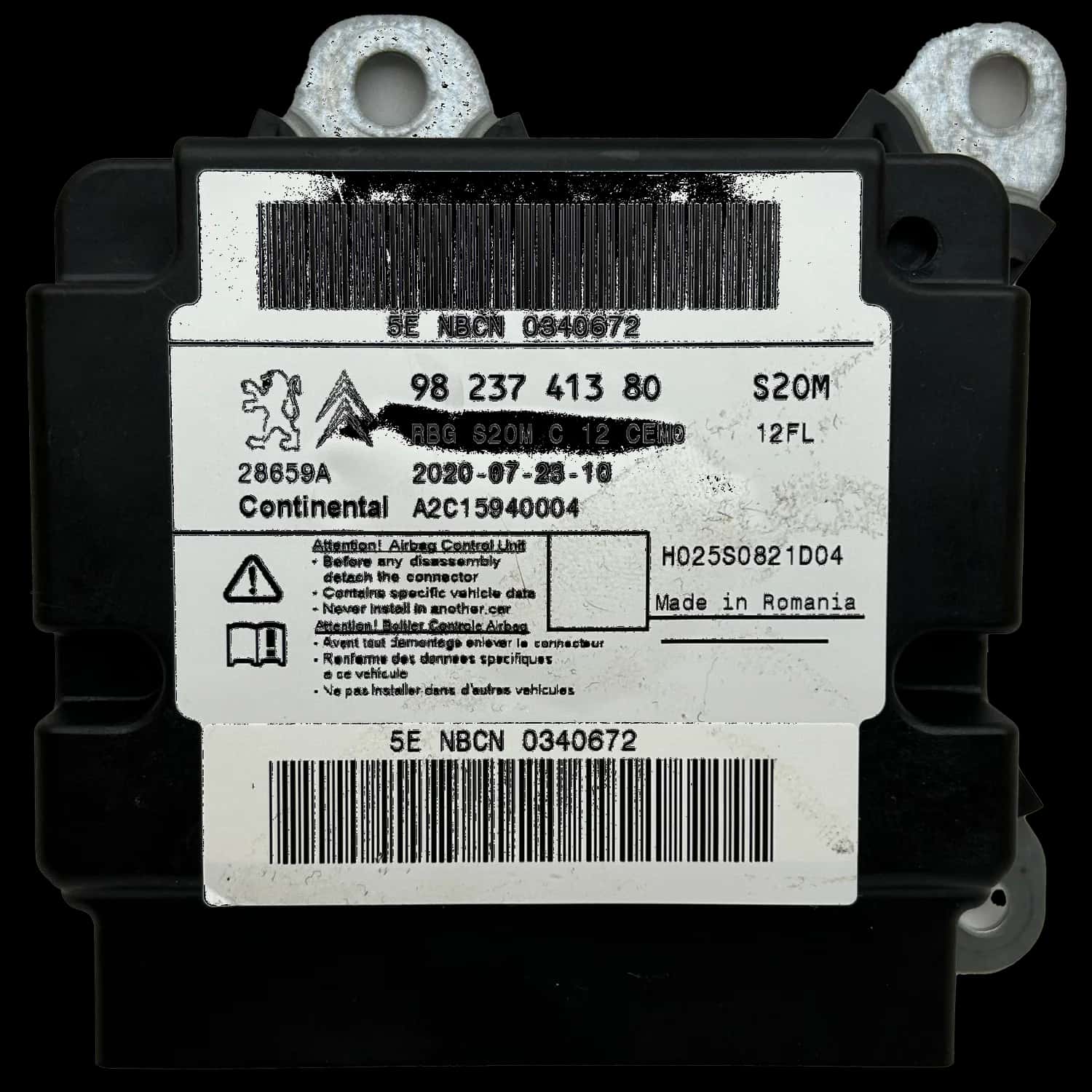
Precisely identifying your Opel Mokka airbag control unit is essential for a successful and safe repair. The part number, often printed on the housing of the control unit itself, serves as the primary identifying feature. A well-known example of this is the control unit with the number 13594408, which is used in certain Mokka models.
In addition, the exact year of manufacture of your Opel Mokka and the corresponding model series (Opel Mokka A or Opel Mokka B) are important parameters to determine the correct replacement or repair procedure.
The airbag configuration of the Opel Mokka varies considerably depending on the model year and trim level. While early models already had basic airbag systems as standard, newer generations feature enhanced safety packages with additional airbag modules and intelligent control functions.
In the first generation of the Opel Mokka A, positioned as a compact SUV, airbags were already integrated as standard to provide solid basic protection for the driver and front passenger. Additional safety packages were often available as options, expanding the scope of the airbag systems, such as side or head airbags, to maximize occupant protection.
The current generation of the Opel Mokka B, which is geared toward an urban lifestyle and offers modern technology, comes with a very comprehensive and modernized airbag system as standard. This typically includes a multitude of airbags strategically placed throughout the vehicle to ensure optimal protection in the event of a collision.
Optional extras can include additional modules or improved sensor technology, further enhancing the safety of the vehicle, which is attractive to both commuters and small families. If the airbag control unit is defective, prompt repair is essential to ensure the full functionality of all these life-saving systems.
Airbag24 repairs your component in Berlin — usually within 3–4 working days.
Standard shipping within Germany is free; we normally return your part by UPS.
You pay for and insure the inbound shipment to us. On explicit request we ship by express — the extra cost is borne by the customer.
If you withdraw from the contract, you bear the cost of returning the item.