
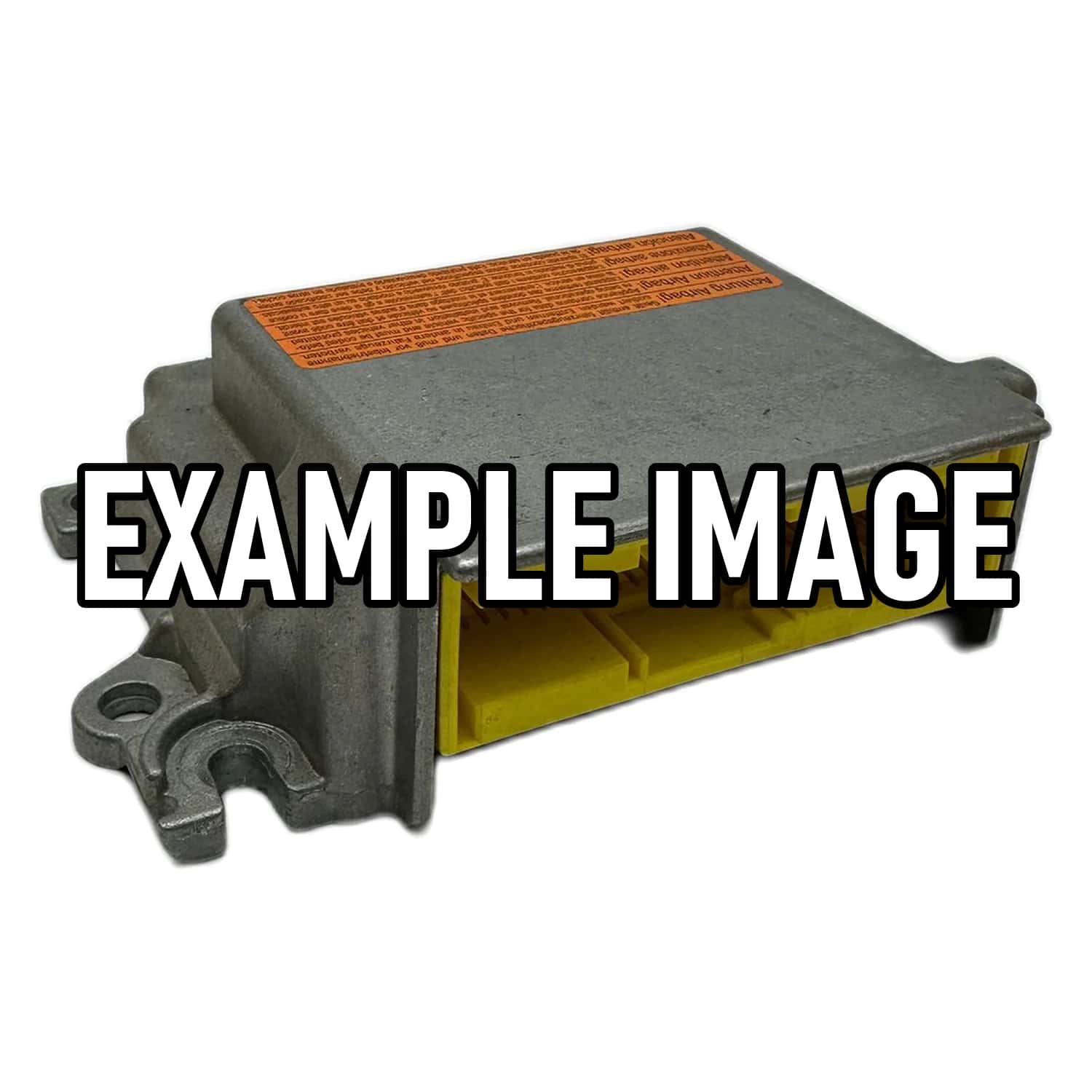
Opel Senator airbag control unit repair(1)
1 product
What should be considered with Opel Senator airbag control units?
The airbag technology used in the Opel Senator varies depending on the model year. Professional repair of airbag control units in all Opel Senator generations ensures the system's original functionality and operational reliability.
The Opel Senator was Opel's flagship model from 1978 to 1993 and a pioneer in terms of comfort and features. With the introduction of airbag systems in the 1980s, the airbag control unit also became a central safety component whose functionality is crucial.
Especially in vehicles of these models, airbag control units can become defective due to aging, corrosion, or internal faults. This can manifest itself in illuminated airbag warning lights or the storage of crash data. A professional repair ensures that the system functions reliably when needed.
Which Opel Senator generations are there?
The Opel Senator was produced in two main generations, each with different airbag control units and safety features. The development of the safety system reflects technological progress from 1978 to 1993.
Opel Senator A (1978 – 1986)
The Opel Senator A, produced from April 1978 to June 1986, was Opel's first luxury model after the KAD series. It was based on the GM V platform and was initially available as a four-door sedan.
A facelift in 1983 resulted in the Senator A2 version, featuring revised design and technical improvements. Airbags were generally not standard in the early production years of the Senator A, but were offered as an option from the mid-1980s onwards, often together with ABS.
The airbag control units installed in these models were simpler than today's systems, but they were crucial for passive safety at the time. Repairing such units requires specific knowledge of the electronics of that era.
Opel Senator B (1987 – 1993)
The Opel Senator B, produced from May 1987 to May 1993, was the successor to the Senator A and was based on the platform of the Opel Omega A. It continued the tradition of the luxurious upper-class vehicle.
Driver and passenger airbags increasingly became standard on the Senator B, significantly raising safety standards at the time. Towards the end of its production run, side airbags were even offered in higher-end trim levels.
The airbag control units in the Senator B were technologically more advanced than those of its predecessor, allowing them to control the more complex airbag systems with multiple airbags. Here, too, specialized repair is essential in the event of defects to ensure the full functionality of the safety system.
How do I identify my Opel Senator airbag control unit?
Opel Senator airbag control units can be uniquely identified by their specific part number, the vehicle's year of manufacture, and the vehicle identification number (VIN). Each generation, and sometimes even certain trim levels, use specific control unit variants for optimal compatibility with the respective airbag system.
The part number of the airbag control unit is the most important identifier. It is usually located on a sticker directly on the control unit. The control unit is often located in the center console, under the front seats, or in the passenger footwell.
The model year of the Opel Senator, whether a Senator A or a Senator B, provides information about the airbag technology used. Furthermore, the full vehicle identification number (VIN) can be used to verify the exact equipment and thus the correct control unit, especially if there is uncertainty about the part number.
What airbag equipment does the Opel Senator have?
The airbag equipment of the Opel Senator varied significantly depending on the model year and trim level. While early models of the Senator A offered airbags only as a rare or later optional feature, newer generations of the Senator B featured enhanced safety packages with standard and additional airbag modules.
Airbags were rarely available in the Opel Senator A during the early years of production. It wasn't until the mid-1980s that driver airbags could be ordered as an optional extra, often in combination with ABS, which underscored the increasing importance of passive safety systems. These systems were still relatively simple in design, focusing primarily on protecting the driver in frontal collisions.
With the model change to the Opel Senator B in 1987, the airbag equipment was significantly improved. Driver and passenger airbags increasingly became standard and were a key selling point for the luxury vehicle. Towards the end of Senator B production, in the early 1990s, some higher trim levels even featured side airbags, making the Senator a very safe vehicle for its time.
The complexity of airbag control units increased in line with the number of airbags and sensors installed. These systems were already capable of storing accident data, which required specialized repair or resetting of the control unit in the event of a defect or after deployment.
Common fault codes in this category
Shipping & repair from Germany
Airbag24 repairs your component in Berlin — usually within 3–4 working days.
Standard shipping within Germany is free; we normally return your part by UPS.
You pay for and insure the inbound shipment to us. On explicit request we ship by express — the extra cost is borne by the customer.
If you withdraw from the contract, you bear the cost of returning the item.