airbag control unit repair Peugeot 306 I
from€79.00
 Quality since 2002
The airbag technology used in the Peugeot 306 varies depending on the model year. Airbag24 professionally repairs control units for all Peugeot 306 models with original functionality and a 2-year warranty.
The Peugeot 306, a popular compact car, was produced by Peugeot from 1993 to 2002. It replaced the Peugeot 309 and was available in various body styles, including 3- and 5-door hatchbacks, convertibles, and station wagons.
In the 1990s, when the 306 was launched, passive safety technology advanced rapidly. Airbags were either standard equipment or optional, depending on the trim level and model year.
The airbag system in the Peugeot 306 was designed to protect occupants in the event of an accident. The central element is the airbag control unit, which acts as the "brain" of the system. This control unit collects crash data and deploys the airbags.
After an accident, the control unit stores the relevant crash information. If this data cannot be erased or the unit itself is defective, the airbag warning light will illuminate continuously. Repairing the airbag control unit is then essential to restore the safety system's full functionality.
The Peugeot 306 underwent several updates and facelifts over its production life, with each phase bringing specific adjustments to the airbag control unit. The development of the safety system reflects the technological progress from 1993 to 2002.
Although the Peugeot 306 never experienced a complete generational change in the sense of a completely new platform, it was continuously updated to keep up with the competition. The initial production phase ran until approximately 2001, before its successor, the Peugeot 307, was introduced.
The station wagon and convertible versions even continued to be produced until 2002. These updates affected not only the design and engine, but also the integrated safety systems, including the airbag control units.
These continuous adjustments mean that airbag control units for the Peugeot 306 can vary depending on the model year and the respective facelift. Precise identification is essential for professional repair.
Peugeot 306 airbag control units can be uniquely identified by part number, year of manufacture, and vehicle identification number. Each production phase used specific control unit variants for optimal compatibility.
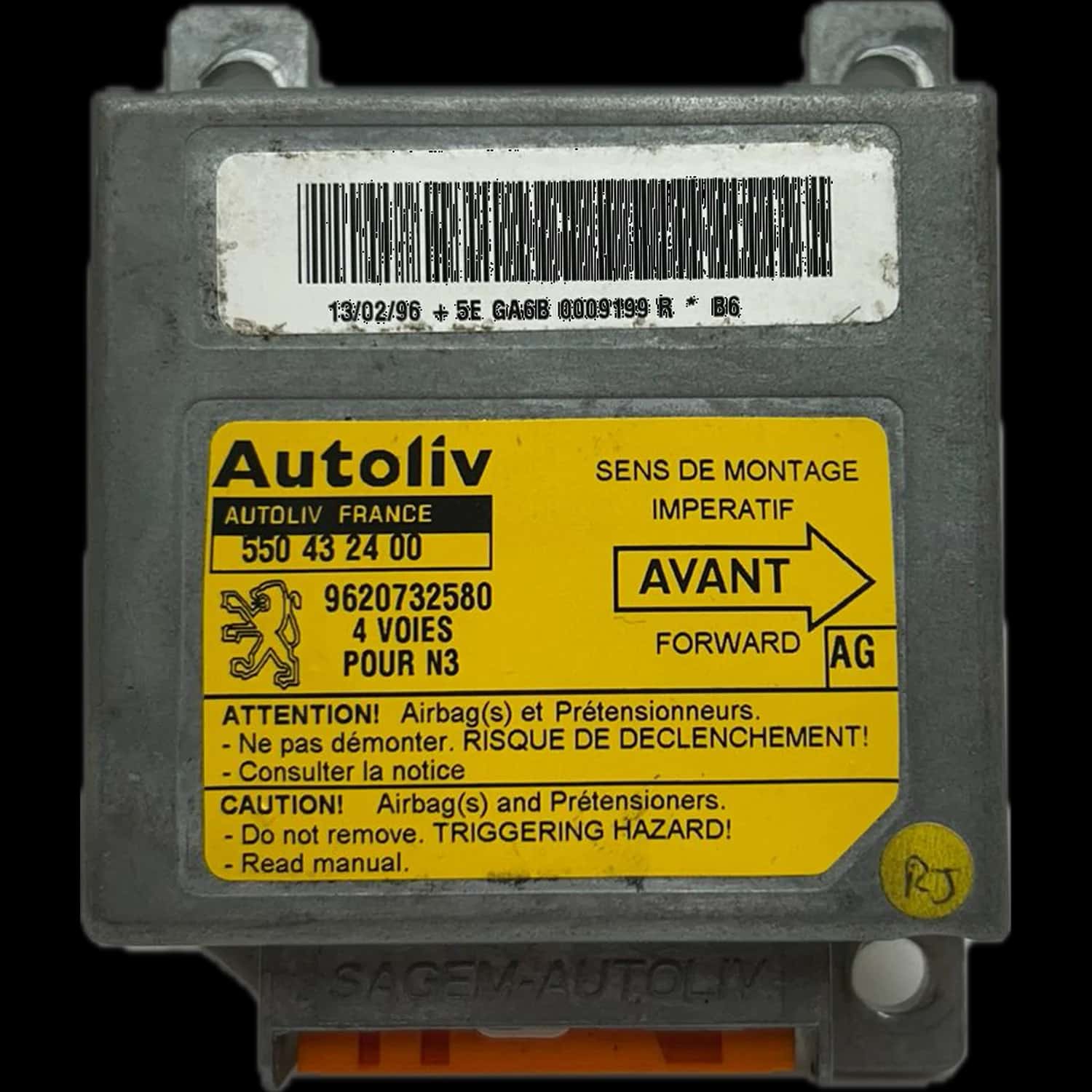
Precise identification of the installed airbag control unit is crucial for a successful repair. The most important identifier is the part number, which is printed directly on the control unit itself, for example, 9620732580.
In addition to the part number, the year of manufacture of your Peugeot 306 and the vehicle identification number (VIN) play an important role. This information can be used to determine exactly which control unit is installed in your specific model and which software version is required for its operation.
Correct identification ensures that the repair is tailored precisely to your vehicle's requirements and that the system functions properly after the repair.
The airbag configuration of the Peugeot 306 varies depending on the model year and trim level. While early models use basic airbag systems, newer versions feature enhanced safety packages with additional airbag modules.
In the early production years of the Peugeot 306, front airbags for the driver and front passenger were the primary passive safety systems. These were designed to mitigate head and chest injuries in a frontal collision.
With ongoing development and the introduction of facelifts, safety features were gradually expanded. In later model years, side airbags and seat belt pretensioners could also be installed as options or as standard, depending on the trim level.
Although the Peugeot 306's safety features were simpler than today's vehicle standards, it offered a solid base of passive safety systems for its time. The exact configuration of the airbag system always depends on the specific model year and the selected equipment of your vehicle.
Airbag24 repairs your component in Berlin — usually within 3–4 working days.
Standard shipping within Germany is free; we normally return your part by UPS.
You pay for and insure the inbound shipment to us. On explicit request we ship by express — the extra cost is borne by the customer.
If you withdraw from the contract, you bear the cost of returning the item.