

Renault Espace airbag control unit repair(6)
What should I pay attention to with Renault Espace airbag control units?
The airbag technology used in the Renault Espace varies considerably depending on the model year and generation. Professional repairs of airbag control units for the Renault Espace ensure true-to-original functionality and full restoration of the safety systems.
The Renault Espace, introduced in 1984 as a groundbreaking MPV, has evolved over six generations into a modern crossover/SUV.
This long production history means a continuous development of vehicle technology, especially in the area of passive safety.
The Renault Espace's airbag systems reflect this progress, from simple front airbags in early models to complex, adaptive multi-chamber systems in the latest generations.
These technological leaps require precise knowledge of the respective model years and their specific system architectures for the repair of the airbag control unit in order to correctly correct defects and restore vehicle safety.
Which Renault Espace generations are there?
The Renault Espace has been produced in a total of six generations, with each generation using different airbag control units and safety systems. The evolution of the safety system reflects technological advances from 1984 to the most recent model years.
The first generation of the Renault Espace (1984–1990) laid the foundation for the concept of the large van and focused on basic safety features.
The Espace II (1991–1996) brought initial improvements before the Espace III (1996–2002) introduced a more comprehensive airbag system with additional airbag modules.
With the Espace IV (2002–2014), state-of-the-art adaptive airbag systems became standard, raising safety to a new level.
The fifth generation, the Espace V (2015–2023), marked the transition to a crossover and incorporated state-of-the-art adaptive airbag technologies. The sixth generation of the Renault Espace, which further raises safety standards, has been in production since 2023.
How do I identify my Renault Espace airbag control unit?
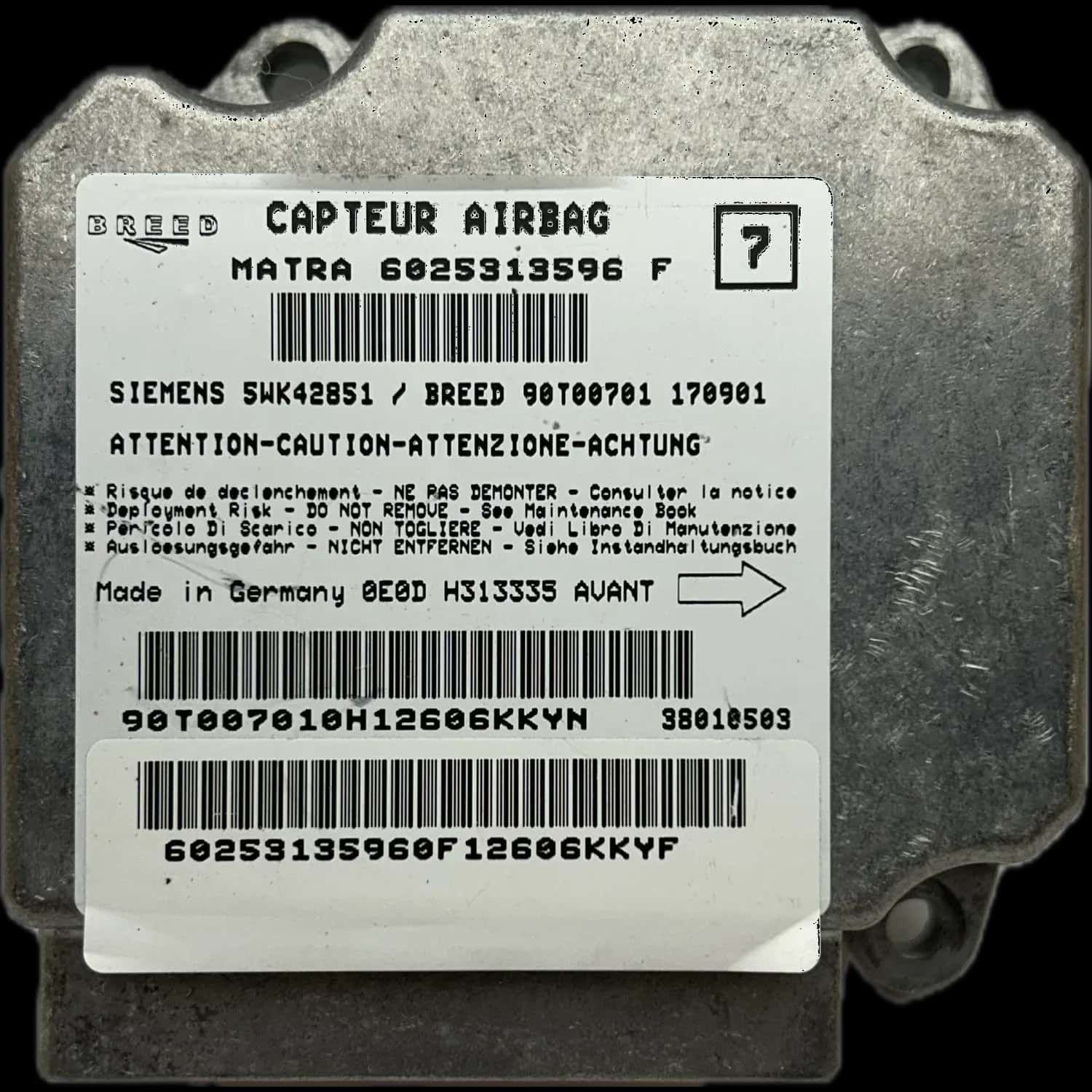
Renault Espace airbag control units can be identified by their unique part number, the vehicle's year of manufacture, and the vehicle identification number (VIN). Each generation of the Renault Espace uses specific control unit variants for optimal compatibility with the respective airbag systems.
Correctly identifying your airbag control unit is crucial for a successful repair and the precise restoration of safety functions.
The part number is usually located directly on the housing of the control unit and is the most important clue for identification.
In addition, the exact year of manufacture of your Renault Espace and the last digits of the vehicle identification number (VIN) are helpful to determine the exact variant.
Exactly matching the airbag control unit with the model year and equipment of your Espace is essential to ensure compatibility and proper functioning of all airbag components, especially if the control unit is defective.
What airbag equipment does the Renault Espace have?
The airbag configuration of the Renault Espace varies considerably depending on the model year, model generation, and specific trim level. While early models used basic airbag systems, newer generations feature enhanced safety packages with a variety of airbag modules.
The Renault Espace I (1984–1990) offered basic front airbags in its later years, which was already advanced for the time.
With the Espace II (1991–1996), these systems were further developed and passive safety was improved.
The Espace III (1996–2002) introduced a comprehensive airbag system that included adaptive front airbags, side airbags for the driver and front passenger, and window airbags (head airbags).
In the Espace IV (2002–2014), these systems were further refined, with state-of-the-art adaptive airbags that adjusted to the severity of the impact and optional airbags for the third row of seats.
The Espace V generation (2015-2023) and the current Espace VI offer state-of-the-art dual-chamber front airbags, side and curtain airbags that react to occupant size and are complemented by rapid inflation mechanisms and sensors in the doors for optimal side impact protection.
These complex airbag systems, which can save lives in the event of an accident, are centrally controlled by the airbag control unit, whose proper functioning must be ensured by professional repair in the event of a defect or after deployment.
Shipping & repair from Germany
Airbag24 repairs your component in Berlin — usually within 3–4 working days.
Standard shipping within Germany is free; we normally return your part by UPS.
You pay for and insure the inbound shipment to us. On explicit request we ship by express — the extra cost is borne by the customer.
If you withdraw from the contract, you bear the cost of returning the item.