CAN-Fehler airbag control unit fault
Control unit repairs for fault code CAN-Fehler in our shop:
Your vehicle isn't listed?
Error “CAN-Fehler” isn't linked to every vehicle in our database – we can usually repair the airbag control unit anyway. Select your vehicle and we'll show you the matching repair:
What does a CAN error in the airbag control unit mean?
A CAN error in the airbag control unit indicates a critical interruption in data communication on the CAN bus. This means the control unit can no longer communicate with other vehicle systems or with the diagnostic tool. Common error codes in this context include U0151 and U0001, which point to a disrupted or failed connection.
The Controller Area Network (CAN) bus is the central nervous system for electronic communication within the vehicle. The airbag control unit continuously exchanges data with sensors and other control units via the CAN bus to ensure system readiness and process information such as seat occupancy.
If this communication fails, the control unit can no longer guarantee its safety functions. The airbag warning light illuminates, and external diagnostics become impossible because no connection can be established with the fault memory. In addition to generic CAN errors like U0151, manufacturer-specific codes in the range C2011–C2014 may also indicate this issue.
How do you recognize a CAN error?
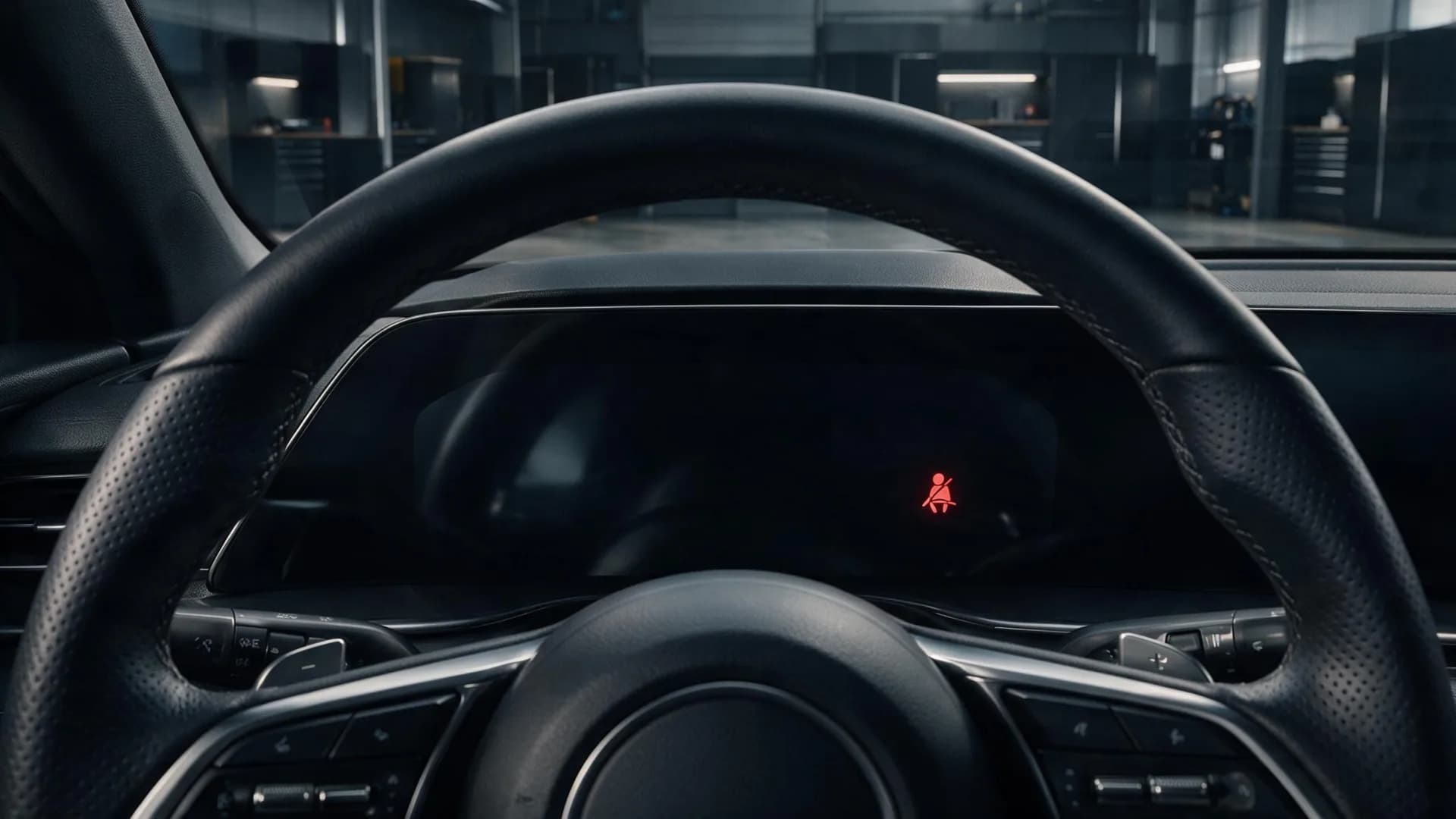
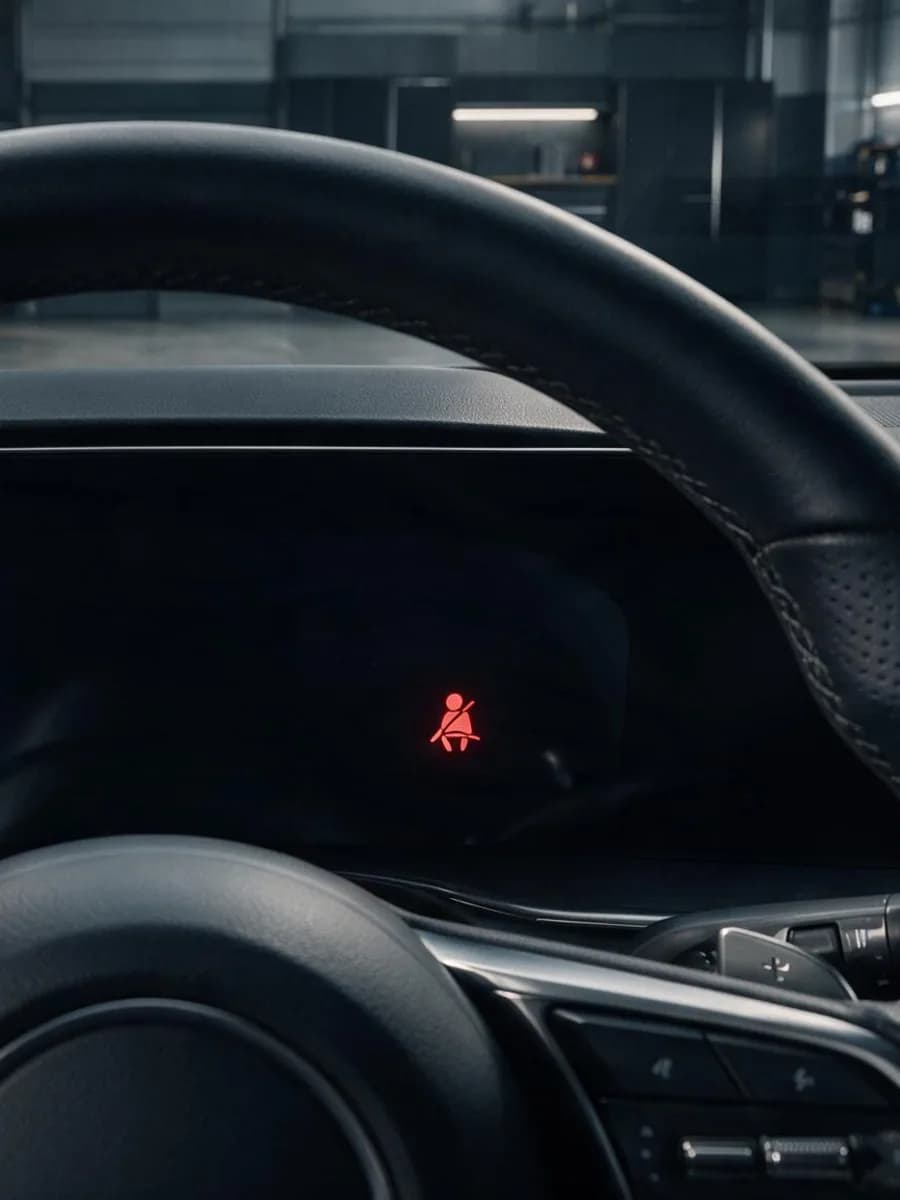
The most obvious symptom is the permanently illuminated airbag warning light on the instrument cluster. At the same time, it is impossible to establish a connection between the diagnostic tool and the airbag control unit. Any attempts to read or clear the fault memory fail because the module is no longer responsive on the data bus.
The activated warning light is a direct signal from the vehicle that the airbag system’s continuous self-diagnosis has detected a serious fault. With a CAN error, the light remains on continuously and does not turn off after starting the engine.
The lack of communication is the key indicator for the workshop. While other faults allow codes to be read, a CAN bus problem completely blocks access. The diagnostic tool typically reports “control unit not responding” or a similar message.
What causes a CAN error?
The primary cause of a CAN error is a physical break in the communication line or an internal hardware defect within the control unit itself. Damaged cables, corroded connectors, water ingress, or overvoltage damage—such as that caused by improper jump-starting (error code 93F9)—can disable sensitive electronics.
Often, external factors trigger the error. Water ingress can lead to short circuits on the circuit board, while mechanical stress—for example, from the constant movement of front seats in three-door models—can damage the connectors leading to the control unit.
Internal component failures are also a common cause. An internal fault, often indicated by code 65535, or voltage issues (codes U3003, U3000) can impair the communication processors inside the control unit, thereby disrupting the CAN bus.
In some cases, stored crash data (e.g., error B1000) can put the control unit into a state where it refuses to communicate. Although the root cause here is a software entry, it produces symptoms indistinguishable from a hardware communication failure.
In which models does the CAN error occur frequently?
CAN bus communication errors in the airbag control unit are a cross-brand issue. At Airbag24, we repair this fault across a wide range of vehicles, particularly for specific models from BMW, Fiat, Iveco, Peugeot, Lancia, and Rover, where this error is known to occur more often.
The vehicles most frequently repaired at Airbag24 include:
BMW: 5 Series F07 Gran Turismo (2009–2013) and F07 LCI Gran Coupé (2013–2017)
Fiat: Multipla 186 (1999–2004) and the facelifted 186 model (2004–2008)
Iveco: Daily II, as well as Tector 5 and Tector 7
Peugeot: 806 first generation (1994–1998) and the facelifted model (1998–2002)
Lancia: Thema second generation
Rover: CityRover S
How is a CAN error professionally repaired?
After sending the removed control unit to Airbag24, a thorough component-level analysis is performed to identify the cause of the communication disruption. The repair involves targeted replacement of defective components, repair of circuit traces, or, if necessary, processor replacement. Finally, flawless functionality is verified, and the repair comes with 2 years' statutory liability for defects.
The process begins with diagnosing the submitted unit. It helps if the workshop documents before removal that no communication was possible, as this provides technicians with valuable clues about the nature of the fault.
The repair itself focuses exclusively on restoring only the actually defective electronic components. This is a major advantage compared to costly full-unit replacement. If crash data following an accident blocks communication, it is safely erased using specialized software.
A distinctive feature of the airbag control unit is that it does not clear fault codes automatically. Each stored fault must be actively reset. After successful repair and testing, the unit can be reinstalled in the vehicle without additional coding.
Is Repairing the Control Unit Worth It?
In almost all cases, repair is the most cost-effective solution. Compared to the price of a new OEM control unit, significant savings can be achieved. Additionally, there’s no need for re‑coding, as the repaired original unit retains its vehicle‑specific configuration.
A new airbag control unit is an expensive replacement part. Repair involves replacing only the defective components, which substantially reduces costs while being more resource‑efficient.
A key technical advantage is preserving the original coding. A new control unit often requires time‑consuming programming to match the vehicle. In contrast, the repaired original part can be installed directly (plug-and-play), saving time and further workshop expenses. All repairs also come with 2 years' statutory liability for defects.
Shipping & repair from Germany
Airbag24 repairs your component in Berlin — usually within 3–4 working days.
Standard shipping within Germany is free; we normally return your part by UPS.
You pay for and insure the inbound shipment to us. On explicit request we ship by express — the extra cost is borne by the customer.
If you withdraw from the contract, you bear the cost of returning the item.
4.8

Based on 246 reviews
What our customers say
„Ok.“
 Zsolt Szabólast week
„Works like a charm!“
 Leoly4 weeks ago
„Everything went perfectly, I can only recommend it.“
Automatically translated · Original: German
 ka irgendwas2 days ago
„From the first phone call, the order processing, to the shipping everything was done very quickly and professionally. Now I still have to send the repaired unit to the Swedish workshop and then hopefully the Honda can fi…“
Automatically translated · Original: German
 Gerd Goldammer2 days ago
„Airbag control unit Fiat 500 was broken. Hard to believe but they can really repair it! Recommendation!!“
Automatically translated · Original: German
 Christian Maegerlein4 days ago
„Everything worked out great! Read out fault memory, sent it in, received offer and sent in the defective control unit. Got it back repaired after 3 days, price exactly as in the offer. It can't get any better 👍“
Automatically translated · Original: German
 Toni Buien5 days ago
„Uncomplicated service. Fast and thorough. Can only recommend.“
Automatically translated · Original: German
 Abdul KS5 days ago
„All great👍“
Automatically translated · Original: German
 Edin Avdic6 days ago
„All great, fast delivery. Thanks.“
Automatically translated · Original: German
 Andrej Ivanovlast week
„100% satisfied. Everything handled very professionally and transparently. Only the return shipping took too long. This was however due to UPS and less to Aairbag24. Thank you very much“
Automatically translated · Original: German
 Dennis Welast week
„VAG airbag control unit with error B2000 00 reliably repaired. Price very high in comparison, but everything worked out. No exact protocol of what was carried out, probably just newly flashed“
Automatically translated · Original: German
 Tokeh Tokehlast week
„A great shop, even when there are sometimes problems. There are quick responses and very good help. I can only recommend the shop. Thank you very much“
Automatically translated · Original: German
 Sven Wegenerlast week
„Ok.“
Zsolt Szabólast week