
Daewoo Honker airbag control unit repair(1)
1 product
What should I pay attention to with Daewoo Honker airbag control units?
The airbag technology used in the Daewoo Honker varies depending on the model year. Professional repair of the control units in all Daewoo Honker generations ensures original functionality and a two-year warranty.
The Daewoo Honker, a rugged off-road vehicle with a long and varied production history from 1988 to 2016, was manufactured by various manufacturers. This diversity in production history also impacts the components installed, including the airbag systems.
Since the Honker was primarily designed as a purpose-built off-road and military vehicle, the focus was initially less on comprehensive passive safety systems. The development of airbag technology in the Daewoo Honker is therefore closely linked to the model years and specific model variants produced under the FSR Tarpan, Daewoo, Intrall, and DZT Tymińscy brands.
Which Daewoo Honker generations are there?
The Daewoo Honker was produced in several versions and facelifts throughout its production run from 1988 to 2016, with each phase potentially using different airbag control units. The evolution of the safety system reflects technological advances and changing requirements over nearly three decades.
The Honker series began in 1988 as the FSR Tarpan Honker, a practical off-road vehicle. After being acquired by Daewoo, the vehicle continued as the Daewoo Honker from 1996 onwards and underwent a moderate facelift, known as the "Honker 2000."
After the Daewoo era, production continued under various Polish manufacturers such as Andoria-Mot, Intrall, and most recently DZT Tymińscy. During this period, further variants emerged, such as the Honker 4x4, the Honker Cargo, and the Honker Pick-up, as well as specialized military versions such as the Honker Skorpion.
Each of these transitions and model updates could lead to adjustments to the vehicle's electronics. This also applies to the airbag control units, whose specifications could vary depending on the model year and the respective manufacturer, which must be taken into account when repairing the defective module.
How do I identify my Daewoo Honker airbag control unit?
Daewoo Honker airbag control units can be uniquely identified by their specific part number, the vehicle's year of manufacture, and often also by the vehicle identification number (VIN). Each version or generation of the Honker may have used specific control unit variants for optimal compatibility with the respective vehicle model.
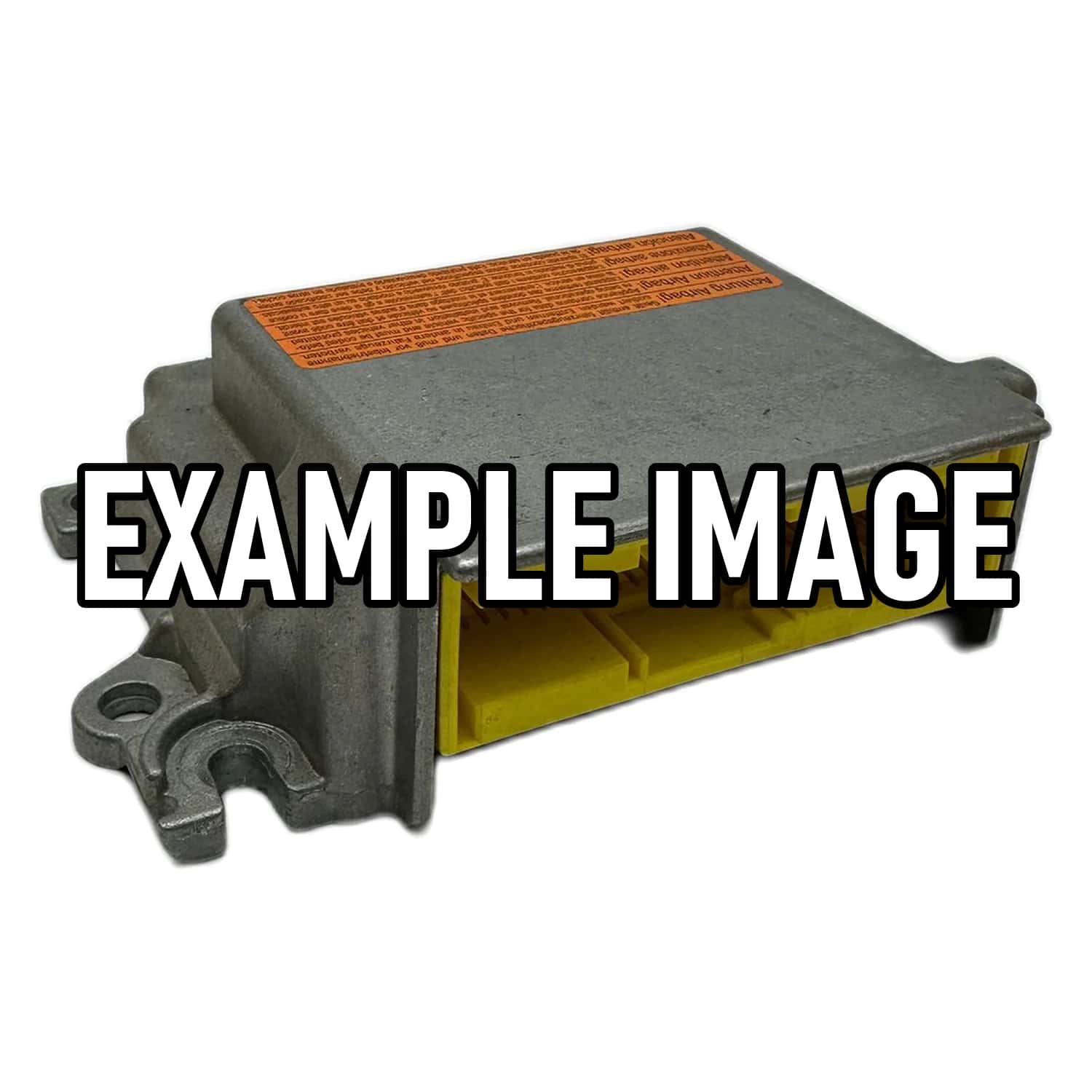
Due to the long production run and the frequent manufacturer changes of the Daewoo Honker, precise identification of the airbag control unit is crucial. The part number is usually printed directly on the control unit housing and serves as the most important reference.
The airbag control unit in the Daewoo Honker, like many SUVs of this era, is usually located centrally in the vehicle, often under the center console or under one of the front seats. The vehicle's model year provides additional clues as to the likely airbag system generation.
The vehicle identification number (VIN) can also be helpful in determining the exact equipment and thus the correct control unit using special vehicle databases. This is especially important to ensure compatibility during repair or replacement and to restore the full functionality of the safety system.
What airbag equipment does Daewoo Honker have?
The airbag configuration of the Daewoo Honker varies greatly depending on the model year and specific version. While early models and purely military variants rarely featured airbags as standard, newer civilian versions may have had basic airbag systems, such as a driver's airbag.
The Daewoo Honker was primarily developed as a rugged off-road vehicle for demanding operations. Its main target groups were the military, police, mining companies like KGHM, and civilian users who needed a robust 4x4 vehicle. In the early years of production and in purely military versions, the installation of airbags was not a priority.
Specific details on the standard or optional equipment of airbags across all Honker model years are not comprehensively documented in the available manufacturer information. However, it can be assumed that as production progressed, especially in civilian export models that were also registered in EU countries and had to meet newer emissions standards, basic safety features such as a driver's airbag were offered as an option or in higher trim levels.
Comprehensive multi-module airbag systems, as is common in modern passenger cars, were rather unusual in the Daewoo Honker, which was designed for practicality and robustness. Equipment details depended heavily on the respective country of destination and specific use, as these vehicles were often custom-built to meet specific fleet requirements.
Shipping & repair from Germany
Airbag24 repairs your component in Berlin — usually within 3–4 working days.
Standard shipping within Germany is free; we normally return your part by UPS.
You pay for and insure the inbound shipment to us. On explicit request we ship by express — the extra cost is borne by the customer.
If you withdraw from the contract, you bear the cost of returning the item.