
Daewoo Lacetti airbag control unit repair(2)
2 products
What should I pay attention to with Daewoo Lacetti airbag control units?
The airbag technology used in the Daewoo Lacetti varies depending on the model year and market. Airbag24 professionally repairs control units of all Daewoo Lacetti generations with original functionality and a 2-year warranty.
The Daewoo Lacetti was produced through two significant generations: the J200 (produced approximately 2002-2011) and the later J300 (produced approximately 2008-2016), also known as the Chevrolet Cruze. These different production periods also represent an evolution in airbag control unit technology.
While earlier J200 models were often equipped with basic airbag systems, the newer J300 benefited from a more modern platform that enabled more comprehensive passive safety systems. This is reflected in the specific requirements and complexity of the respective airbag control units, which are crucial for professional repair.
Which Daewoo Lacetti generations are there?
The Daewoo Lacetti was produced in two generations, each using different airbag control units. The development of the safety system reflects technological advances from 2002 to 2016.
The first generation, the Daewoo Lacetti J200, was built from 2002/2003 to approximately 2010/2011 and sold in Germany between 2004 and 2010. This model was also known internationally as the Chevrolet Lacetti, Chevrolet Nubira, or Suzuki Forenza and included various body styles such as sedan, station wagon, and hatchback.
The second generation, the Daewoo Lacetti J300, launched in 2008 and was produced until approximately 2016. Technically known as the Daewoo Lacetti Premiere or Chevrolet Cruze, it was based on the more modern GM Delta II platform. Although it was a further development, minor updates and facelifts were made within each generation to keep it current.
Production of the J300 thus overlapped with that of the J200 for several years before the latter was completely replaced. These generational changes are crucial for correctly identifying and repairing the airbag control unit, as the components and systems installed can differ significantly.
How do I identify my Daewoo Lacetti airbag control unit?
Daewoo Lacetti airbag control units can be uniquely identified by part number, year of manufacture, and vehicle identification number. Each generation uses specific control unit variants for optimal compatibility and correct operation.
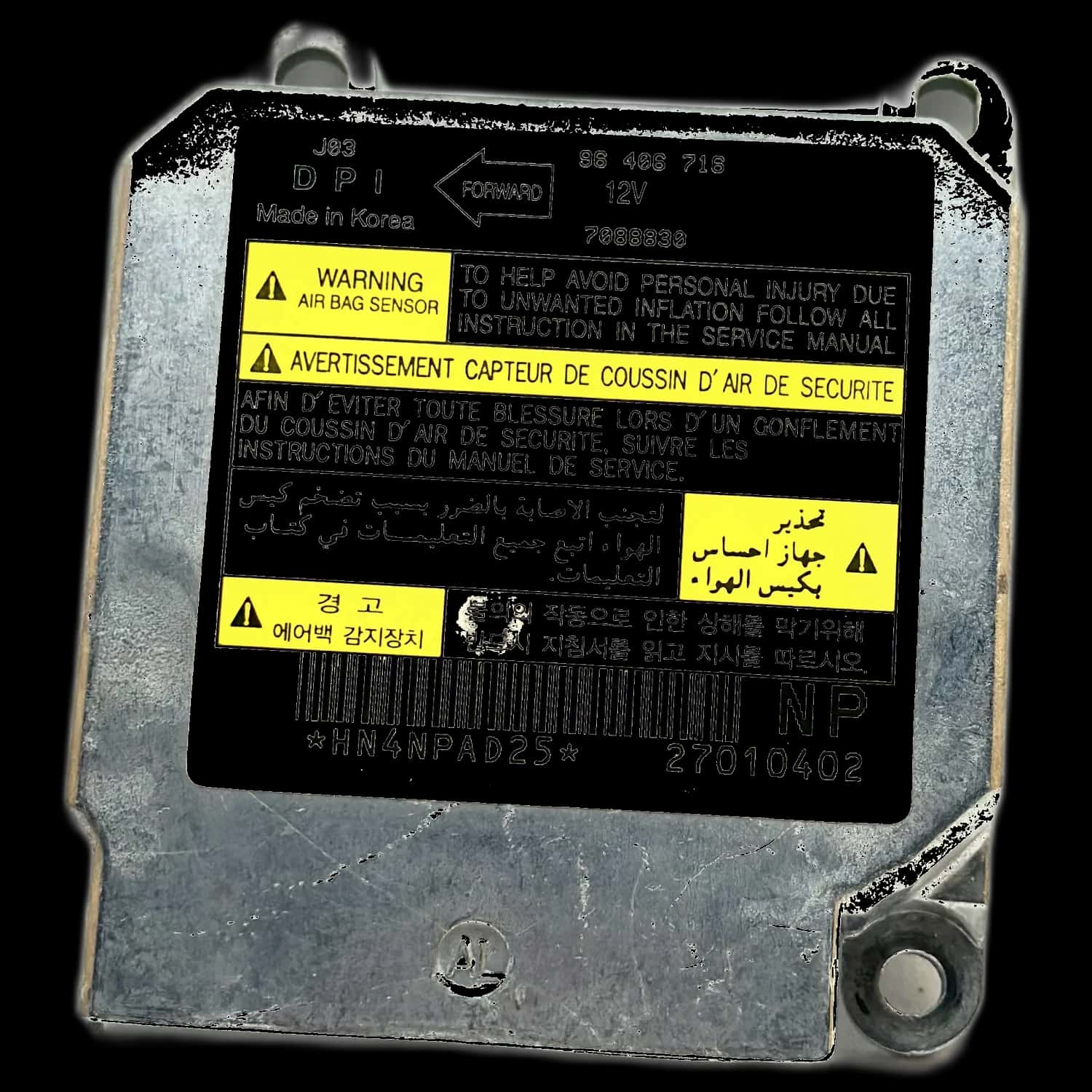
Precise identification of your Daewoo Lacetti airbag control unit is essential for a successful repair. The part number can be found directly on the control unit's housing. This number is the most important clue for determining the exact model and its specifications.
Additionally, the exact year of manufacture of the vehicle and, ideally, the vehicle identification number (VIN) are important tools. Especially for models produced in the transition years between the J200 and J300, this can help avoid confusion and ensure the compatibility of the control unit with the specific vehicle. Accurate identification ensures that the repaired unit fits perfectly into your airbag system.
What airbag equipment does Daewoo Lacetti have?
The airbag configuration of the Daewoo Lacetti varies depending on the model year and trim level. While early models use basic airbag systems, newer generations feature enhanced safety packages with additional airbag modules that meet increased safety standards.
The Daewoo Lacetti J200 typically came with driver and passenger airbags as standard equipment in the base trim. Depending on the market and trim level, side airbags or curtain airbags could be added as options or were included in higher trim levels. The focus here was on providing solid basic protection.
With the introduction of the Daewoo Lacetti J300 (Chevrolet Cruze) in 2008, passive safety technology was upgraded. The more modern GM Delta II platform allowed for the integration of more comprehensive airbag systems. This often included a larger number of standard airbags, including side and sometimes curtain airbags, which became mandatory or were in higher demand in many markets.
The evolution of airbag systems from the first to the second generation of the Lacetti reflects general advances in vehicle design and the increasing importance of passive safety. A repair of the airbag control unit must take these specific features and the number of integrated airbag modules into account to restore the full functionality of the safety system.
Shipping & repair from Germany
Airbag24 repairs your component in Berlin — usually within 3–4 working days.
Standard shipping within Germany is free; we normally return your part by UPS.
You pay for and insure the inbound shipment to us. On explicit request we ship by express — the extra cost is borne by the customer.
If you withdraw from the contract, you bear the cost of returning the item.