

Nissan X-Trail airbag control unit repair(4)
4 products
What should I consider with Nissan X-Trail airbag control units?
Airbag technology in the Nissan X-Trail has evolved continuously across the various model series. The airbag control unit, the heart of the passive safety system, is crucial for the functionality of all installed airbags and seatbelt pretensioners.
The Nissan X-Trail has been launched in a total of four distinct generations, beginning with the T30 series in 2001. Each new generation brought not only design and performance improvements but also significant advances in safety technology. This evolution from the T30 through the T31 and T32 to the current T33 demonstrates Nissan's commitment to occupant protection.
With each generation, the airbag system also adapted to increasing safety requirements. While early models offered solid basic features, later versions integrated increasingly complex systems and sensors. This means that the airbag control units of each model series have specific features and algorithms, making professional repair essential to ensure full functionality.
Which Nissan X-Trail generations are there?
The Nissan X-Trail has been produced in four main generations, with each model using specific airbag control units and associated safety systems. The evolution of these systems reflects technological advances from the early 2000s to the present day.
The first generation of the Nissan X-Trail (T30) was produced from 2001 to 2007 and established the model as a robust SUV for families and leisure. It was followed by the second generation (T31) from 2007 to 2013, which featured a refined appearance and improved handling. The third generation (T32), produced from 2014 to 2022 and facelifted in 2017, focused on more modern connectivity and expanded driver assistance systems. The fourth generation (T33) has been available since late summer 2022, setting new standards in the family SUV segment with hybrid drivetrains and state-of-the-art safety technology.
How do I identify my Nissan X-Trail airbag control unit?
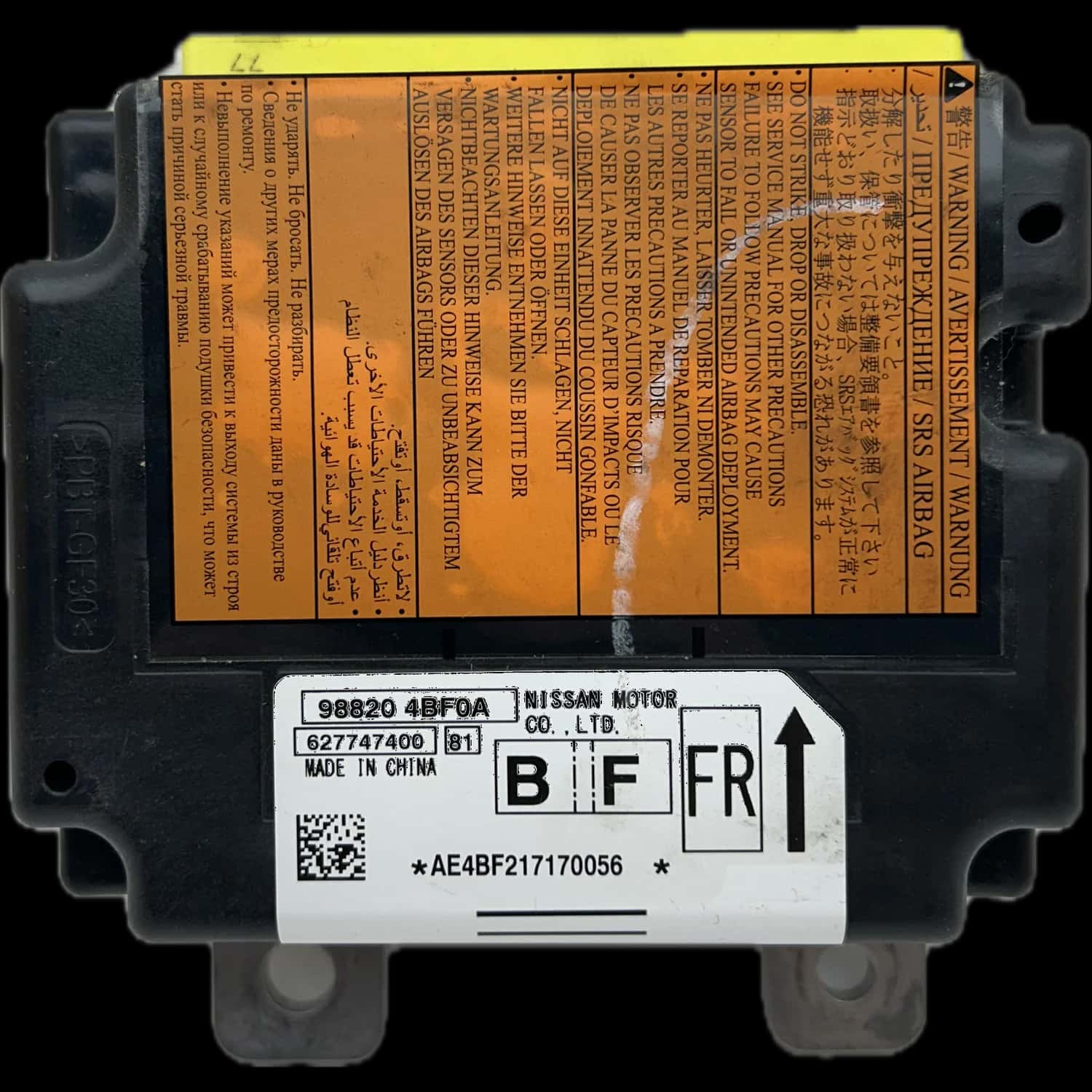
Nissan X-Trail airbag control units can be uniquely identified by their specific part number, the exact year of your vehicle, and the vehicle identification number (VIN). Each generation, and often specific model years within a generation, use specific control unit variants to ensure optimal compatibility with the respective vehicle system.
The part number of the airbag control unit is the most important clue for correct identification in the event of a necessary repair. This number is usually located directly on the module housing, which is typically located under the center console or driver's seat. The year of manufacture and the vehicle identification number (VIN) are also important, as these data provide information about any model updates or country-specific equipment that may affect the installed components. Accurately specifying these details enables precise identification and professional repair of the defective control unit.
What airbag equipment does the Nissan X-Trail have?
The Nissan X-Trail's airbag equipment has become increasingly comprehensive over the model generations and varies depending on the model year and specific trim level. While earlier models offered a solid basic level of protection, newer generations feature significantly expanded safety packages with a higher number of airbag modules and intelligent control functions.
Even the first generation of the Nissan X-Trail (T30) was equipped with basic safety features as standard, including driver and front passenger airbags, often supplemented by side airbags for the front passengers. With the introduction of later generations, especially from the T32 onward, the passive safety system was significantly expanded and optimized for the family SUV. In addition to front and side airbags, full-length curtain airbags are standard, providing comprehensive protection for all rows of occupants.
Modern airbag control units in the Nissan X-Trail, particularly in the T32 and T33 generations, are also capable of providing detailed diagnostic information and storing crash data in the event of an accident. A defect in the airbag control unit or the storage of crash data after an accident typically causes the airbag warning light in the cockpit to illuminate. In such cases, a professional repair, including erasing the crash data, is essential to restore full system functionality and ensure safety. Some variants of the X-Trail also offer the option of manually deactivating the front passenger airbag, which is particularly useful when a child seat is installed in the front passenger seat.
Shipping & repair from Germany
Airbag24 repairs your component in Berlin — usually within 3–4 working days.
Standard shipping within Germany is free; we normally return your part by UPS.
You pay for and insure the inbound shipment to us. On explicit request we ship by express — the extra cost is borne by the customer.
If you withdraw from the contract, you bear the cost of returning the item.