
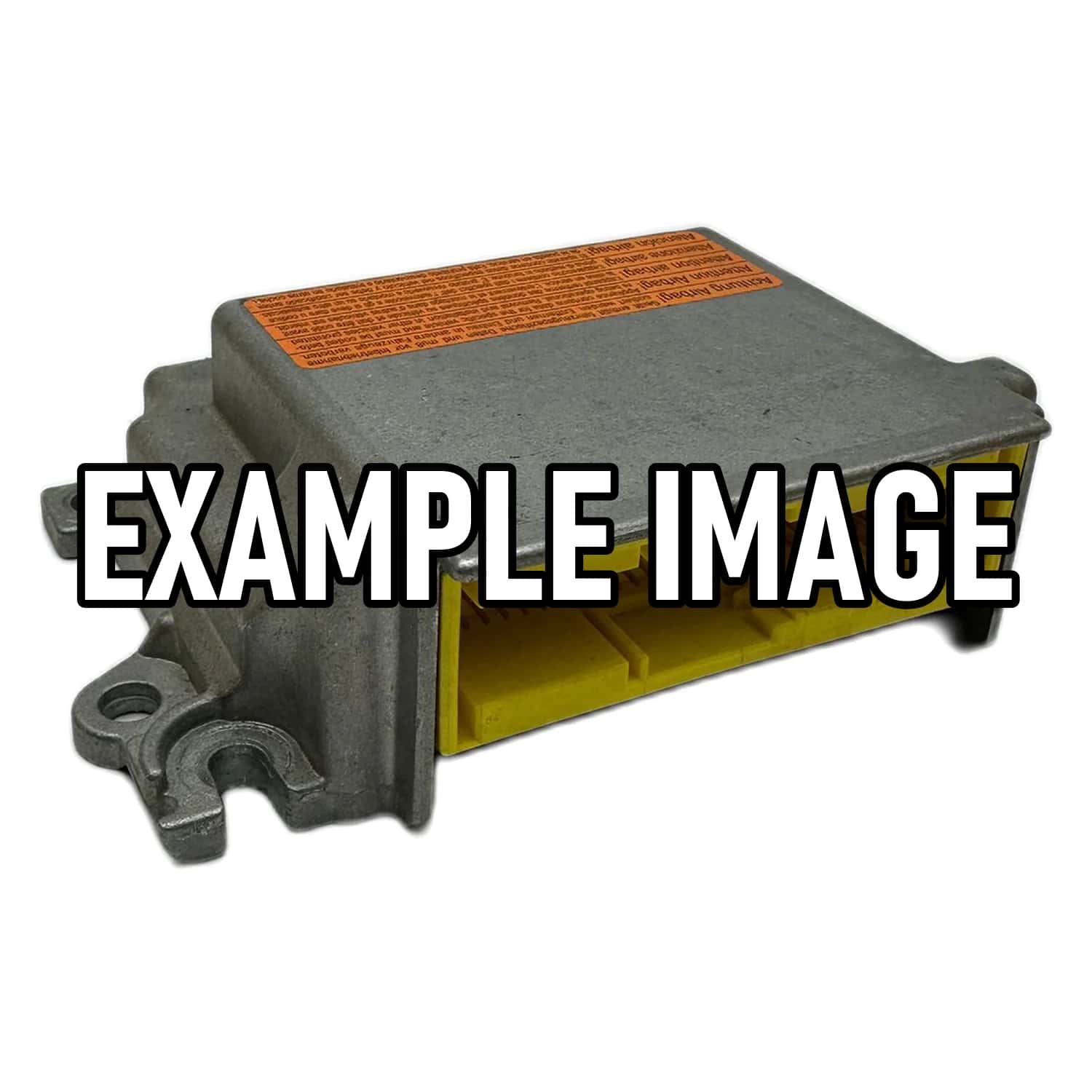

Pontiac Firebird Airbag Control Unit Repair(6)
What should I look out for with Pontiac Firebird airbag control units?
The airbag technology used in the Pontiac Firebird varies depending on the model year. Professional repair of airbag control units is crucial to ensuring the vehicle's original functionality and safety.
The legendary Pontiac Firebird was produced from 1967 to 2002 and, as an iconic pony car, shaped several eras of American automobile construction. Its development over four generations always reflected technological advances and changing demands for performance and safety. The later models from 1990 onward are particularly known for their advanced passive safety systems.
Initially, early Firebird models did not have airbags, as this technology was not yet ready for production or widespread. A significant turning point came in 1990/1991, when the driver airbag was introduced in the third generation. With the fourth generation, built from 1993 to 2002, dual airbags for the driver and front passenger became standard in all Firebird variants. This marked a significant leap in safety features.
Which Pontiac Firebird generations are there?
The Pontiac Firebird was produced in four generations, each using different airbag control units. The evolution of the safety system reflects technological advances from 1967 to 2002.
The first generation (1967–1969) established the Firebird as a direct competitor to the Ford Mustang, still without airbag systems. The second generation (1970–1981) deepened its status as a muscle car, but focused primarily on performance and design. The third generation (1982–1992) began the integration of airbags, initially as an option, but from 1991 onwards largely as standard equipment for the driver's airbag.
The fourth and final generation (1993–2002) represented the most comprehensive development, featuring a more aerodynamic design and standard dual airbags. Models such as the Firebird, Formula, Trans Am, Trans Am WS6, and Trans Am Ram Air of this period benefited from this enhanced safety equipment. It is in these later generations, in particular, that airbag control unit repair plays a relevant role.
How do I identify my Pontiac Firebird airbag control module?
Pontiac Firebird airbag control units can be uniquely identified by part number, model year, and vehicle identification number (VIN). Each generation uses specific control unit variants for optimal compatibility and system integration.
Precisely identifying your airbag control unit is crucial for a successful repair or replacement. The part number can usually be found directly on the control unit itself, which is often located under the center tunnel or behind the center console. Since the technology varied over the years, the exact production year of your Pontiac Firebird is essential for correct identification.
Third-generation models (from 1990/1991) use different control units than fourth-generation models (1993-2002), which are designed to control two airbags. Even within a generation, there may be differences in models due to facelifts or trim levels. Comparing the part number with the year of manufacture and the specific model variant (e.g., Trans Am, Formula) ensures that the repaired control unit is a perfect fit for your vehicle.
What airbag equipment does the Pontiac Firebird have?
The Pontiac Firebird's airbag configuration varies considerably depending on the model year and trim level. While early models use basic airbag systems, newer generations feature enhanced safety packages with additional airbag modules.
Before 1990, the Pontiac Firebird did not have airbags, which was state-of-the-art in the USA at the time. Starting with the 1990 and 1991 model years, the third-generation Firebird introduced a driver's airbag in the steering wheel. Initially, it was partly optional but quickly became standard. This was a significant step forward for the pony car's passive safety.
The decisive turning point came with the 4th generation (1993 to 2002). Two airbags, for both the driver and passenger, were standard equipment in all Firebird variants. This included models such as the Firebird, Formula, Trans Am, and the performance variants Trans Am WS6 and Trans Am Ram Air. The integration of dual airbags underscored the Firebird's claim to be a sporty vehicle that also met modern safety standards.
Shipping & repair from Germany
Airbag24 repairs your component in Berlin — usually within 3–4 working days.
Standard shipping within Germany is free; we normally return your part by UPS.
You pay for and insure the inbound shipment to us. On explicit request we ship by express — the extra cost is borne by the customer.
If you withdraw from the contract, you bear the cost of returning the item.