

Pontiac Trans Am Airbag Control Unit Repair(3)
3 products
What should I look out for with Pontiac Trans Am airbag control units?
The airbag technology used in Pontiac Trans Ams varies considerably depending on the model year and generation. As experts in airbag control units, we professionally repair units for all Pontiac Trans Am generations with original functionality and offer a 2-year warranty on our work.
The Pontiac Trans Am, a sporty version of the legendary Firebird, was produced in four different generations from 1967 to 2002. This long production period represented a continuous development of vehicle technology, including safety and airbag systems.
Airbag technology developed rapidly over these decades. While early Trans Am models had no or only rudimentary safety features of this kind, airbags became standard in later generations, especially from the 1990s onward. This required increasingly complex airbag control units, which are crucial for the reliable function of the passive safety system.
Which Pontiac Trans Am generations are there?
The Pontiac Trans Am was produced in four main generations, each with specific features and—crucial for airbag control unit repair—different airbag systems and associated control units. The evolution of the safety system reflects technological advances from 1967 to 2002.
The first generation (1967–1969) of the Firebird, which evolved into the Trans Am, did not use airbags. The second generation (1970–1981) also generally did not have airbags, as this technology was not yet widely used in passenger cars.
It wasn't until the third generation (1982–1992) and its facelifts that airbags began to be introduced, usually as an option for the driver. Particularly relevant models such as the Trans Am GTA from 1987 onwards or the exclusive GTA Notchback (1988/1989) may have already featured such systems, even if they weren't yet standard across the board.
The fourth and final generation (1993–2002) of the Pontiac Trans Am represented a significant leap forward. Driver and passenger airbags were generally standard equipment. Performance variants like the Pontiac Trans Am WS6, Pontiac Trans Am Ram Air, and Pontiac Trans Am Firehawk, which were popular during this era, utilized the most advanced safety systems available at the time, centered around the airbag control unit.
How do I identify my Pontiac Trans Am airbag control module?
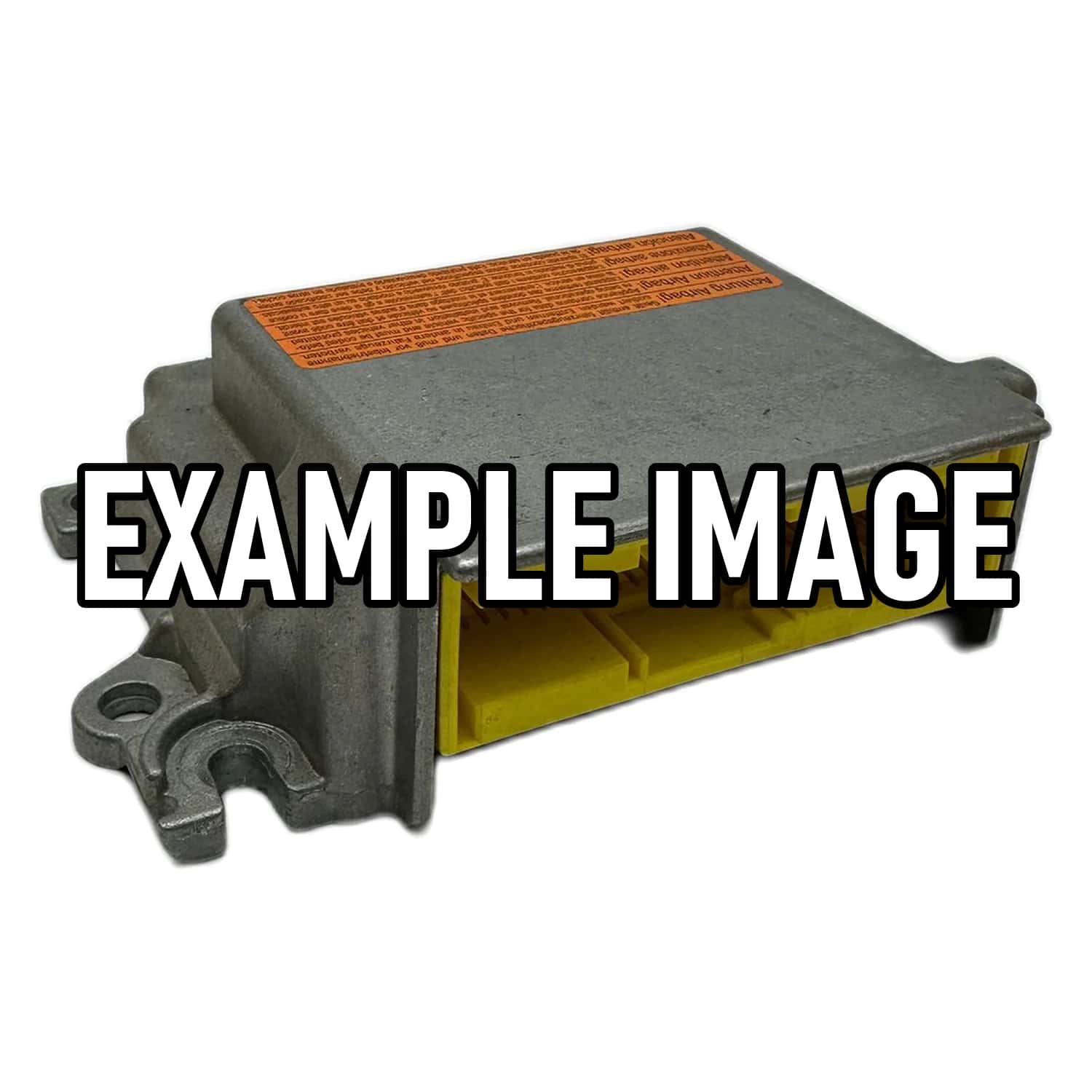
Pontiac Trans Am airbag control units can be uniquely identified by the part number printed on the housing, the exact year of manufacture of the vehicle, and often also by the vehicle identification number (VIN). Each generation, and sometimes even certain model updates, use specific control unit variants to ensure optimal compatibility and functionality with the installed airbag modules.
Correct identification is crucial, as even within a generation, different suppliers or software versions can lead to different control units. The part number is the most important indicator. It is usually located on a sticker directly on the control unit, which is usually located in the center console or under the dashboard.
Additionally, information such as the exact model year and trim level (e.g., WS6, Ram Air, Firehawk) can provide further clues as to the control unit variant used. Although the Trans Am performance packages included specific suspension or engine modifications, they generally used the airbag control units standardized for the respective generation, making identification by part number even more important.
What airbag equipment does the Pontiac Trans Am have?
The Pontiac Trans Am's airbag configuration varies greatly depending on its production year and trim level. While early models up until the 1980s had few or no airbag systems, newer generations feature increasingly advanced safety packages with multiple airbag modules and corresponding control units.
In the first two generations of the Trans Am (1967-1981), airbag technology was virtually nonexistent. The vehicles relied on passive safety provided by the body structure and seatbelts. With the third generation (1982-1992), airbags began to be integrated, often initially as optional equipment designed to protect the driver. These were simple systems that required a control unit to deploy each airbag.
The real change came with the fourth generation (1993-2002). Driver and passenger airbags were generally installed as standard, requiring a significantly more complex control unit. These control units not only monitored deployment in the event of an impact but also stored important crash data.
High-performance variants of this fourth generation, such as the Pontiac Trans Am WS6, the Pontiac Trans Am Ram Air, and the Pontiac Trans Am Firehawk, also benefited from this development. Their safety features were standard at the time and included the standard airbag systems developed for all fourth-generation Firebird/Trans Am models to meet increased safety requirements.
Common fault codes in this category
Shipping & repair from Germany
Airbag24 repairs your component in Berlin — usually within 3–4 working days.
Standard shipping within Germany is free; we normally return your part by UPS.
You pay for and insure the inbound shipment to us. On explicit request we ship by express — the extra cost is borne by the customer.
If you withdraw from the contract, you bear the cost of returning the item.